
2026 World Cup: Welcome to Grace on Football's Coverage!
It's soccerin' time!

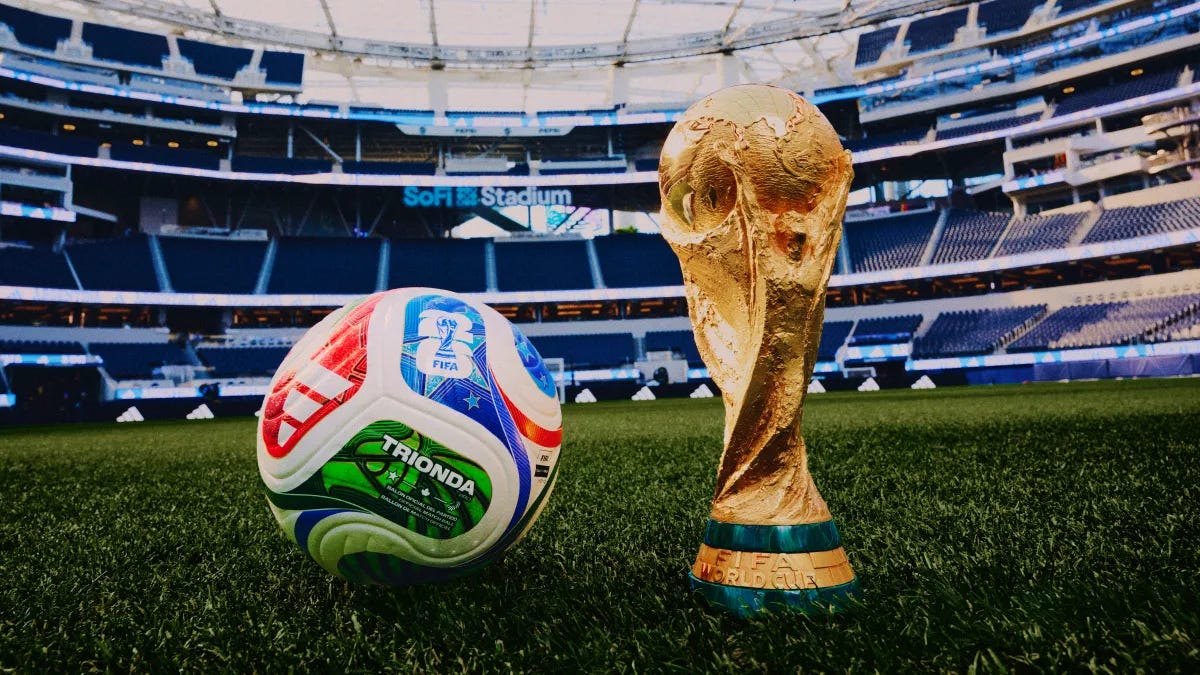
Ok, let’s get to the important bit before I ramble on about my usual bullshit:
The World Cup starts on Thursday. You may have heard about this.
I will be writing a newsletter every single matchday, covering something on all the games played (save for the 24th June when the very talented Catalina Bush will be covering for me)
Half of these articles will be free, and half will be for paid subscribers
If you become a paid subscriber right now, you will get a special offer with 20% off for the first year.
That works out at £4.80/$6.40/€5.60 a month, or you can save in the long run by getting a whole year for £48/$64/€56. I believe all major currencies are accepted, but you’ll have to check on the exchange rates.
This gets you access to the paid newsletter every day as well as the opportunity to join our Discord server and chat about everything that’s happening with like-minded folks
Alright, then. Let’s get into it.
When the United States hosted the World Cup in 1994, it felt like a geopolitical statement and the dawn of a new era. It was the first World Cup after the end of the Cold War. America had won so completely in the battle for the future that its ideas and values were to take hold everywhere. It only stood to reason, then, that America would get to have football’s biggest event. It had everything else. It was the 90s. You were going to pledge allegiance to the flag of liberal democracy and free market capitalism. There was no alternative.
That held true for a while. The 1998 tournament was held in France as the country celebrated the brilliant “Black, Blanc, Beur” (“Black, White, Arab”) national team made up of a racially diverse squad celebrating a more open and tolerant country. Four years later, Jacques Chirac comprehensively beat Jean-Marie Le Pen in the French presidential election with 82% of the vote, to show a country utterly rejecting the politics of the far right1.
2002 saw the World Cup head to Asia for the first time, with Japan and South Korea hosting together. This felt like a new horizon for football, unlocking audiences and spreading the word. The sport could be more than just Europe and South America. For the first time, the World Cup could truly belong to the world.
2006 kept that good feeling going. Germany hosted the event for the first time since reunification and used it as an opportunity to show everyone that it had become a modern, open and tolerant country. The tournament was a huge success, arguably proving to be the best off-pitch experience of any modern World Cup.
Then we reached arguably the peak of the “more open and tolerant world” model: South Africa in 2010. This is the tournament where Didier Drogba rushed back from a broken arm to play in the competition because Nelson Mandela called him and said one of Africa’s biggest football stars needed to be at the first African World Cup. As the South African football journalist Melissa Reddy put it, “the streets cascaded with an electricity that seemed to sit on the skin, a rapture that you couldn’t shake”. Apartheid was long over. South Africa was part of a newer, better world, and football was witness to it.
Then things started to change. I don’t think anyone would dispute Brazil’s claim to host a World Cup. Personally speaking, I’d say it was the most enjoyable edition I have watched at home on television. But there were things we didn’t see onscreen. The country had pretty large protests against FIFA and the World Cup. There was real anger at the way the tournament sucked up money from cities in Brazil with little return. All of this was largely absent from broadcasts. I often think about the comedy satire website ClickHole’s 2014 article, “7 Differences Between The TV Version Of The World Cup And The Novel”. It makes some very silly jokes, then sneaks in with the macro-story of the tournament: “The large-scale demonstrations protesting the relocation of impoverished Brazilians are largely glossed over by the TV version, whereas they are a prominent storyline in the book”.
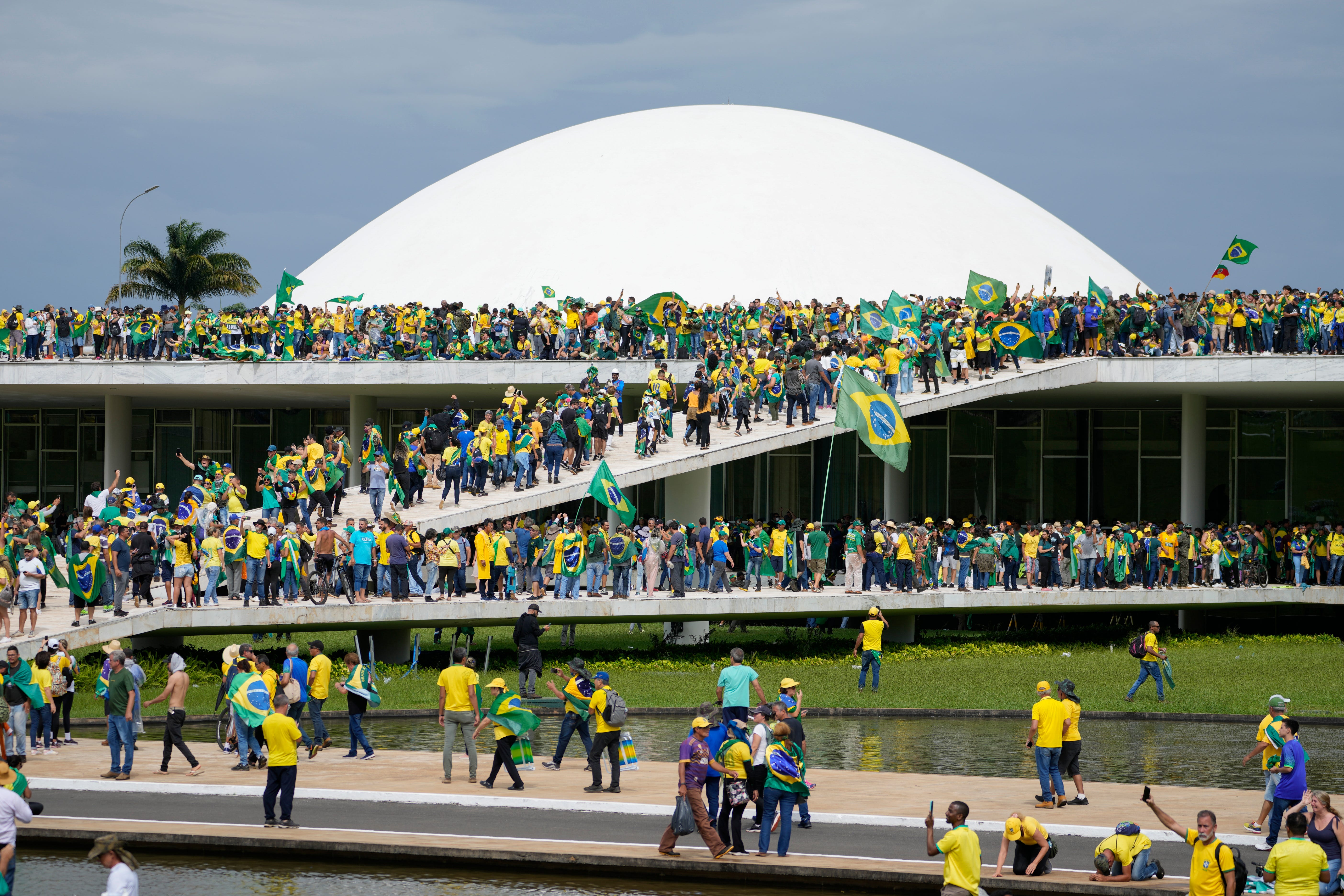
If you remember anything at all about that World Cup, it’s probably the hosts losing 7-1 to Germany. If the Seleção is a symbol of Brazilian identity, then public anger was at a real high. Over time, once left-wing protests against the country’s government morphed into a strange kind of far-right politics, reaching its pinnacle once Jair Bolsonaro was elected President. When Bolsonaro lost in his re-election bid, his supporters stormed the government buildings in the country’s capital, all wearing their own uniform: yellow Brazil national team shirts. I’m not saying this all stemmed from the World Cup, but it’s not not a part of the story.
FIFA got engulfed in a corruption scandal pretty quickly after the 2014 World Cup. President Sepp Blatter resigned, opening up a brief possibility for real reform that got very quickly shut down. Gianni Infantino, formerly of UEFA and the embarrassment of a “research centre” known as CIES, won the FIFA presidential election by saying whatever any voters wanted to hear. The man clearly had no intention of cleaning up FIFA, but his grand vision would reshape the flavours of corruption going forward.
Next up was Russia in 2018. For all the political controversy beforehand, this tournament felt like an unambiguous success story for Vladimir Putin. “I think we were sportswashed four years ago when we were in Russia", then-BBC presenter Gary Lineker said in 2022. A lot was said in the West about all sorts of problems Russia’s World Cup might have, which meant that Putin scored a PR win when it all ran smoothly. Based on the media coverage, ordinary Russians turned out to be perfectly lovely people, which helped shift the narrative away from the Putin regime’s obvious issues. This was textbook sportswashing in that the football created a positive image and shifted everyone’s attention away from the serious issues. Then Russia launched a full-scale invasion of Ukraine four years later, and it’s still happening. Again, the World Cup was a tiny piece of this, but it didn’t exactly hurt.
Qatar 2022 was different in that sense. I don’t think Qatar wanted to host the World Cup for pure sportswashing reasons. It was partially about bragging rights. They obviously wanted everyone to have a brilliant time and think “wow, what a lovely country”. US broadcaster Fox Sports, for example, had reportedly planned to cover the tournament remotely on the cheap before Qatar Airways stepped up with a significant sponsorship deal. But they didn’t just want to project a friendly image. They wanted to project a powerful image. Alcohol was banned from stadiums at the last minute, in a blow to FIFA and its commercial partner Budweiser, seemingly just to show who was in charge here. Qatar used the World Cup as a tool to get the planet’s attention and make everyone listen. In that regard, it was a huge success.
It is 2026 and, once again, America is hosting the World Cup. And once again, there is no alternative.
Regardless of what’s happening in the White House, this was always going to be different. Russia and Qatar were both awarded their hosting status back in 2010 under Blatter’s presidency. Back then, the FIFA executive committee got to decide and, being a very small number of people, their decisions could be opaque. But Infantino changed that. In the new model, each FIFA member country (meaning that nation’s football administrator) would get one vote. Democracy, if that means Gibraltar carrying as much weight as India. With a very large number of member organisations being notoriously corrupt, this system once again runs on bribes and self-interest. The more things change, the more they stay the same.
But Infantino’s other big World Cup promise was to expand the tournament to 48 teams, up from 32. This is a great vote winner because it means an awful lot of countries have an increased chance of playing at the World Cup. But it also means more games, requiring more venues, more training facilities, and just generally more. Fewer countries can logistically host such a large tournament, especially with restrictions about continents having to sit out the next two World Cups after hosting one. Morocco provided the only other bid, which was considered to be much higher risk than the North American option due to the lack of existing infrastructure. Realistically, it was always going to be the “United 2026” bid.
If not for the 48-team tournament, FIFA might have preferred Morocco. It is not especially democratic, and the World Cup would be very important to the country, meaning FIFA could theoretically strongarm the government into doing all sorts of things that suited the executives. But Infantino’s grip on the organisation is weaker than Blatter’s, and the members chose North America.
The main reason this bid won, of course, is to make money from the American consumer. I can’t really judge FIFA here since I’m trying to do the exact same thing with this newsletter. But that’s the prize. A lot of rich people live in the United States. FIFA can sell astronomically high tickets to them. Brands can pay FIFA to market to them. Everyone gets a big ol’ slice of the American pie. Drove my Chevy to the levee, and the levee was overflowing with cash. The idea of including Canada and Mexico made everyone feel good about a more united, open and tolerant continent.
The challenge was always going to be logistics. When you have a World Cup across three different countries and 14 different states or provinces, coordination is going to be hard. And with the exception of Mexico, these places are not especially motivated by the idea of hosting the World Cup. Countries usually make a lot of exceptions to host a World Cup because they really want it to go well. Laws are temporarily changed. Things are different for ordinary citizens feeling the hype of the tournament. Not this time. The average person in New York or Los Angeles will not particularly care about the tournament. These places hold major sporting events all the time, and the World Cup isn’t automatically a special category for them. For perhaps the first time ever, FIFA has to play by the rules here.
This is why FIFA must have felt like they won the lottery in November 2024.
Donald Trump is their kind of guy. He can be bribed. He can be corrupted. He can bend the rules to suit their needs, if they suck up to him hard enough. So that’s what Infantino has done. He’s tried to become Trump’s best friend, making big gestures and positioning himself as the administrator of the MAGA World Cup. He invented the FIFA Peace Prize to give it to Trump. It has worked to an extent, and Trump has clearly enjoyed the way Infantino butters him up. But I’m not sure it’s been worth a great deal. It hasn’t ensured every player and official makes it through US customs. It hasn’t prevented the Iran national team from having to stay in Mexico despite their games happening in the US. Infantino has kissed the ring over and over, but the mafia protection doesn’t seem to be happening.
The only thing we know it’s definitely accomplished is tarnishing the World Cup brand by associating it with such a globally disliked figure. Great job, Gianni.
Ok, ok, that’s nearly 2,000 words about politics. Let’s get down to why we’re actually here in the first place.
I love the World Cup. I love it more than the entire rest of football combined. Yes, the tactical and technical quality is not as high as elite European football. No, I don’t think any side playing in North America this summer could beat Paris Saint-Germain. But it’s a different beast entirely. There’s a simplicity to international football that can’t be replicated. The stakes are much cleaner. I don’t need to explain the relevance of Germany to non-football fans the way I might with Bayern Munich. The best football match I’ve watched in recent years, by far, was the 2022 World Cup final between Argentina and France. Before that, the last one that struck a chord with me so deeply was Germany’s 7-1 win over Brazil in 2014. I can’t totally explain it. It’s the World Cup. It just hits different. Even when the football isn’t great, it hits.
There are… a lot of games on at this tournament. And, being spread over multiple time zones, the kick-off times are labyrinthine. There is going to be so much football happening at so many times, almost all of it extremely late if you’re on my side of the Atlantic. The “earliest” kick-offs for UK viewers are at 5 pm, while the “latest” games will end just before 7 am the next morning. I think a lot of us are used to football catering to the European consumer, and that just isn’t happening here. Even if you live on the East Coast of the US, that’s from noon to 2 am. If you’re on the West Coast, that’s 9 am to 11 pm. And I’m assuming most of you have jobs and lives and such happening.
I’m going to be covering every matchday and every game here. You’ll be able to read my analysis of what you’ve just watched and learn about the games you missed because you’re a functioning adult with stuff on. Here’s an example of the kind of daily newsletter I wrote during the last World Cup. I think the format might be a little looser this time, just because there are likely to be more games without a huge amount of intrigue, so I reserve the right to keep my thoughts shorter on a boring match if something really exciting happens elsewhere.
I do, as ever, intend to get pretty nerdy about stats and tactics while keeping it accessible. If you want a tiny trade secret, my usual approach (which I’m told other people also do) is to imagine myself saying these newsletters to my dad. If it sounds too nerdy or insular for a conversation with him, it’s not getting published. I’m going to be writing a lot of words in this tournament, and hopefully most of them are pretty good.
To be clear, I won’t stop talking about the political issues. But I’ll hopefully find the right way to weave them together with discussion about what’s happening on the pitch. For all my anger at so much surrounding the tournament, I remain genuinely excited about it, and I hope you’re willing to come along for the ride with me.
Please subscribe with the new offer!
Once again: I have a special offer running right now, giving you 20% off for a year. That’s £4.80/$6.40/€5.60 a month, or you can save in the long run by getting a whole year for £48/$64/€56. I feel incredibly honoured that this has become a viable business, and it’s entirely because of all of you. Now, let’s get ready for all the football you can imagine.
France’s electoral system means that the final presidential election is fought between only two candidates