
Goodbye, Mo Salah.
Liverpool's "just right" superstar moves on

Sometimes things are meant to be, but not at that exact moment.
Liverpool liked Mohamed Salah for a long time. That’s why they really wanted to sign him from Basel in January 2014. The rumours had been swirling for a couple of months that the club had made him their number one target that transfer window. The infamous “transfer committee”, largely driven by director of technical performance Michael Edwards, were sold on the player. “But the proposed transfer fee kept on increasing”, Liverpool’s director of research Ian Graham wrote in his book, How to Win the Premier League, “enough to make me very nervous. It looked like we’d have to break the Swiss transfer record by 50% to secure the services of [him].
“In the end my nervousness didn’t matter. Basel stopped taking our calls. We’d been gazumped by Chelsea. The price had already increased to £12 million, way beyond the Swiss record. But Chelsea had been offered £40 million by Manchester United for Juan Mata. With money to burn, they offered Basel £20 million and Basel stopped negotiating with us.”
Chelsea saw Salah as a depth piece and a potential member of the infamous “loan army” spearheaded by then director of football Michael Emenalo. Playing a 4-2-3-1 formation, José Mourinho liked to start Eden Hazard, Oscar and Willian in the band of three attacking midfielders behind the striker. André Schürrle was often used off the bench, but Mata had been sold, and Kevin De Bruyne decided he didn’t want to sit around not getting chances. They were a little short, and Salah filled a role in the squad while also scuppering a rival’s transfer plans.
Salah started six league games over the rest of the season, playing 500 minutes, which could have been a reasonable bedding-in period. Not for Mourinho. Late in the campaign, Salah started a low-stakes Premier League match against Norwich before getting taken off at half time. Mourinho was apparently furious at his players during the interval, especially Salah, telling him to come back next season “ready to be a footballer”. John Obi Mikel claims that Mourinho “massively ripped into him […] he destroyed the kid and then pulled him off”. In the following campaign, he played just 33 minutes of Premier League football before getting loaned out to Fiorentina in January 2015. José’s done it again.
The easy conclusion is to say that history tells us Salah made the wrong choice (or had the wrong choice made for him), that he was later able to correct. He was always “supposed” to go to Liverpool, but it just took him a few years longer than it needed to. But to be honest, I’m not convinced things would’ve turned out much better for him had he chosen red over blue in 2014. At the time, Brendan Rodgers had built an incredibly exciting counter-attacking side around Luis Suárez and Daniel Sturridge, with a young Raheem Sterling increasingly becoming the third prong in that attack. Rodgers was very stubborn in his feuds with the transfer committee, preferring “his” players in his attempts to accrue power. I think Salah would’ve found himself on the bench here. The following season, Suárez was sold, and Sturridge suffered from injuries, so the team did naturally have a Salah-shaped hole. But would Rodgers have used the Egyptian? Would he have put him out at wing-back, or even favoured Jordon Ibe at times to make a point to the owners? I don’t think Salah moving earlier is a slam dunk.
Anyway. Salah went on loan to Fiorentina and impressed pretty quickly in his six months in Florence, enough for the club to activate their option to buy. Salah wasn’t interested in making the move permanent, which caused some controversy, but more immediately, it meant he would spend the 2015/16 season on loan at Roma instead. There, he looked a pretty useful wide forward, prompting the Giallorossi to make the move permanent, and Salah said yes to this club. He was even better the next year, getting 15 goals and 11 assists in just over 27 games worth of minutes in Serie A, but he didn’t get the headlines because Edin Džeko was having a monster season upfront. That meant Salah was always going to be a supporting player a little further from the box than he’d like.
A smarter club might have recognised that Džeko was 31 while Salah was 25 and seen where the future of the team lies. But not Roma. Džeko was the side’s biggest star, and Salah could be sold for a healthy profit. Liverpool hadn’t forgotten about him. “We had little competition from within the Premier League”, Graham explained. “He’d ‘failed’ at Chelsea and our English rivals did not want to risk repeating Chelsea’s mistake.”
Jürgen Klopp’s Liverpool were showing signs of promise at this point. The front three of Philippe Coutinho, Sadio Mané and Roberto Firmino were very exciting, and not exactly lacking in terms of pace and movement. Coutinho and Mané both missed stretches of the 2016/17 season, with Divock Origi being the first attacker off the bench. Daniel Sturridge was still around, but injuries had taken their toll, and he lacked the acceleration of a few years earlier. They were really struggling for depth options, and another attacker was needed. At the same time, Klopp wanted to move Coutinho into a deeper role and play with two “explosive” wingers rather than an explosive winger and a “playmaker” winger. Klopp took some persuading, presumably because of the consensus view that Salah “failed” at Chelsea. “Michael Edwards, [director of recruitment] Dave Fallows, [chief scout] Barry [Hunter], they were really in my ear and were on it: ‘Come on, Mo Salah, he’s the solution!’”
Liverpool fans really love a superstar to really worship and get behind. During the 2000s, they celebrated Fernando Torres with a religious fervour. The day he left the club, they bought Suárez (and someone else we don’t need to mention), who seamlessly slotted into the now vacant “god figure” role. When Suárez was sold to Barcelona in 2014, it wasn’t clear who would become the icon here. Supporters really got behind Mario Balotelli in a way that perhaps surprised outsiders, but obviously, he did not end up fitting the bill.
Coutinho had largely become that figure, though, personally speaking, I’m not sure his performances quite merited it. But the way the Liverpool fans can get behind star players is a good way to market yourself into a superstar, so Coutinho found himself on Barcelona’s radar after that club lost Neymar. Salah was never intended as a replacement. Liverpool absolutely did not want to sell Coutinho until Barça and the player were so insistent and willing to pay the absolute maximum fee. He was to complement what they already had, not to build around.
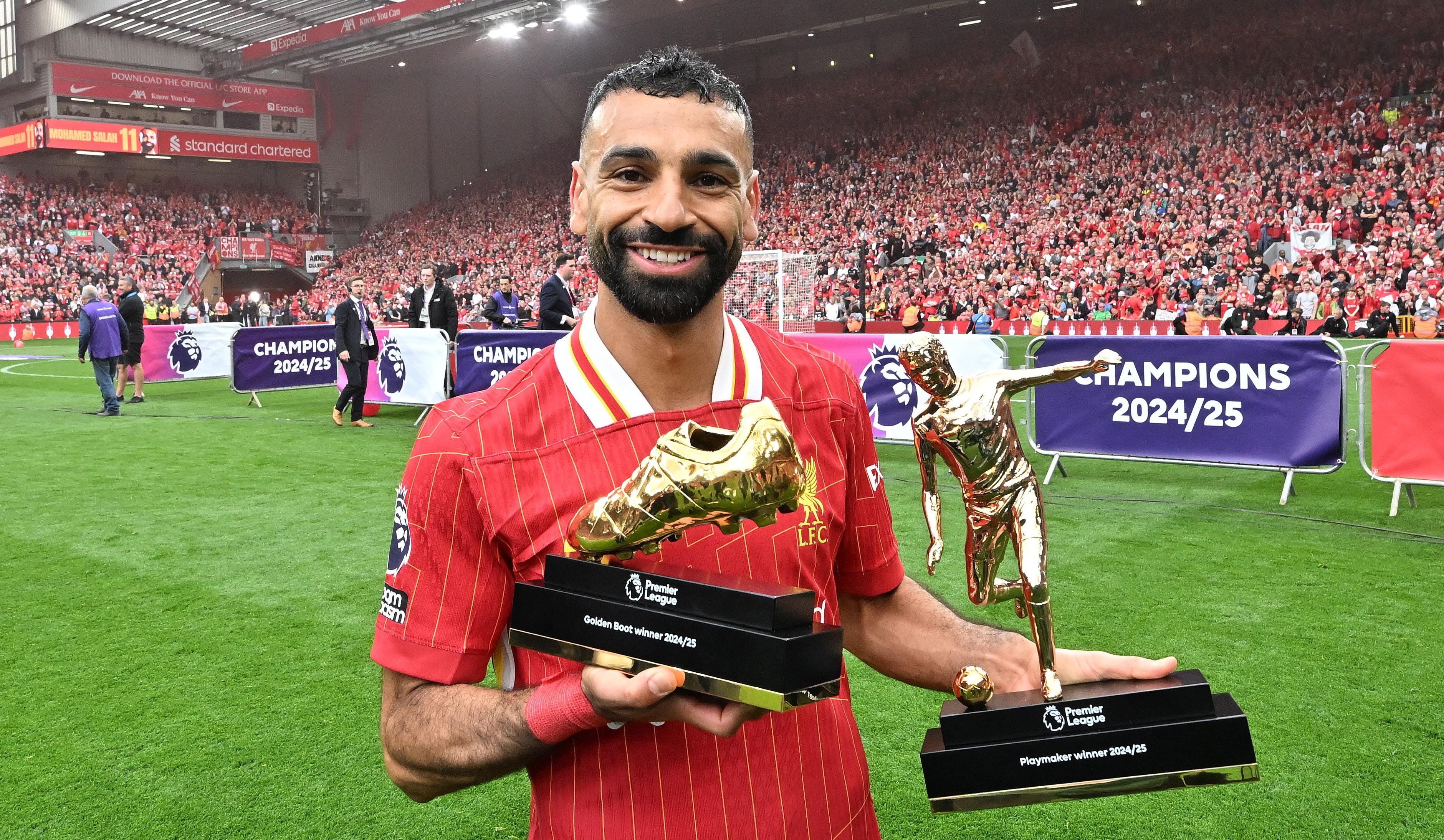
That changed pretty quickly. By the end of calendar year 2017, he’d scored 17 Premier League goals (zero penalties) at a rate of about one every 90 minutes. By the time he played football in 2018, Coutinho had been sold, and everyone knew Salah was this team’s superstar. He ended the Premier League season on 32 goals, both the PFA and football writers’ player of the year awards, and enough respect that Sergio Ramos seemed to think the best chance of winning the Champions League was to take Salah out of the game after half an hour.
Nerds did correctly point out that he overperformed xG that campaign, but not by a ludicrous margin. We were looking at about 24 expected goals and 8 expected assists, in what should still be considered his best season at Anfield. The team really played for Salah that year. Mané and Firmino increasingly had to sacrifice their own games to get the Egyptian into goalscoring positions. He turned up at Liverpool and immediately turned it into his team.
Things did come back down to Earth a bit in the next couple of seasons. His next three campaigns saw him score an average of 16-17 non-penalty goals each league campaign, along with 10 assists each year. These are outstanding numbers for a wide forward, yes, but one with a balanced role in a team. After that blockbuster first year, Klopp gradually pivoted to giving Salah and Mané more similar tactical roles in the team, spreading out the good work more evenly. Salah was first among equals here rather than the obvious king.
Of that classic front three, I’d never call him a lazy player, but he was less of an absolute pressing machine the way Firmino and Mané were. Liverpool clearly made pressing a priority in the transfer market, adding the late Diogo Jota in September 2020, then Luis Díaz in January 2022. These players did offer something different, but the essential formula didn’t really change until Darwin Núñez arrived in summer 2022. History will be harsh on this signing. “The difficulty with Núñez”, according to Graham, who left Liverpool around this period, “was that he was a very different type of player to Firmino. My questions were: ‘Are we going to change our style or formation for him?’ Is he a good enough player that it might be worth making those changes?’
“I wouldn’t say that the data said no to Nunez. It’s more ‘if we sign this player we have to understand this is the role we’ve seen him be effective in and is there currently a slot for him in our squad?’. And if you’re spending a large amount of money on a player then he has to start. The worst thing you can do is buy a squad player and spend money that could be out there on the pitch.”
Salah was, in theory, the player who could suffer most from a genuine number nine upfront. He was the one benefiting from Firmino creating space for a wide forward to attack and score goals. But, for reasons I can’t quite explain, Salah and Núñez really hit it off. They had a telepathic understanding on the pitch at times. It doesn’t really make tactical sense, but I wish they had more time playing together. I think there was something worth developing there.
That didn’t happen. Klopp left to be replaced by Arne Slot, who really did give Salah a lot of trust in the team. “I told [Slot], ‘look, as long as you rest me defensively, I will provide offensively’”, Salah said in a surprising moment of honesty after winning the Premier League last season. Slot tweaked the formation to a 4-2-3-1, with Dominik Szoboszlai as the number ten and usually two of Díaz, Diogo Jota and Cody Gakpo playing left wing and striker. That meant three very fluid, interchanging and hard-working attacking players willing to do the boring bits to let Salah shine. This was “his” team, and he delivered big time in terms of raw goals and assists. There is air in those numbers, but they still look outstanding. The 29 goals included nine penalties, even as he finished in line with his xG. The 18 assists were slightly better than expected, but it still all comes out at about one non-penalty expected goal and assist per 90. Liverpool did a lot to make Salah’s life easier, but he certainly delivered on his end of the bargain.
So then we get to what we now know will be his last season in red. I think he’s both meaningfully declined and had to face a different tactical environment. Hugo Ekitike has offered a genuine striker option occupying space in the box, but without the understanding Salah had with Núñez. Ekitike and Florian Wirtz have been less proactive in pressing to cover for the Egyptian. The whole thing feels so poorly thought out that I’d have to assume the club had an eye on transitioning him out of the side starting from now, except he had just signed a new contract.
But that’s not what I’ll remember. What I’ll remember is the sheer level that he hit the cultural stratosphere. Everyone from the Financial Times to Pop Base has reported on his exit. He arguably did more than anyone over the last decade to change people’s mental image of where a “superstar” footballer is supposed to be from and what they’re supposed to look like. He was probably more notable as a cultural icon than as a footballer, and he was damn good at football.
Even if he made it at Chelsea, I don’t think there’s a world where he gets afforded the same superstar stature he reached at Liverpool. Hazard was already established in that role. If he went to an even bigger club like Real Madrid or Barcelona, he might have been a bit lost among the sheer concentration of big names. Liverpool was exactly the right spot for him to make a huge impact. It was a perfect fit of club and player at exactly the right time for each.
So long.