
How on Earth did Spurs get here?
When, exactly, did Tottenham take such a wrong turn?

“The English-style manager comes in and wants to get rid of half the players and bring in his own, so the club writes off millions, selling at a loss and buying all over again. The odds are always stacked against that quick fix, so the new manager goes after two years and you’re back to square one, writing off another £10m.”
For most of the last 15 years or so, I had been working on an assumption that went like this:
The Premier League was split into the top six and the rest. That didn’t guarantee those teams would finish in the top six places every season. What it did mean was that if any of those teams had a truly disastrous season, an “everything that could possibly go wrong, went wrong” year, the worst they could do was finish midtable. Think Chelsea in 2015-16, in which they had the José Mourinho implosion in the first half of the season followed by Guus Hiddink and players phoning it in, but still finished tenth. That’s as bad as it would get. For the other 14 teams in the division, a season where everything went wrong would mean relegation.
That’s clearly over now. It’s been over for a little while. Tottenham Hotspur, Manchester United and Chelsea have all put up bottom-half finishes this decade, and there’s an actual chance Spurs could pay the big price. They’re currently sitting in 16th, but only one point ahead of West Ham in the relegation zone. In terms of the statistical modelling, Scott Willis of Cannon Stats gives Tottenham a 28% chance of going down, while Simon at Analytic FPL has the figure at a much more cautious 10%. I think Scott and Simon are both pretty smart at this sort of thing, so there really is a lot of uncertainty here. The major bookies are punchier on this, with their odds putting the implied probability at around 33-40%, though it’s worth saying this isn’t a very “liquid” market, and might be responding to a fair few “dumb” bets from rival supporters who just think it’d be really funny if Tottenham get relegated.
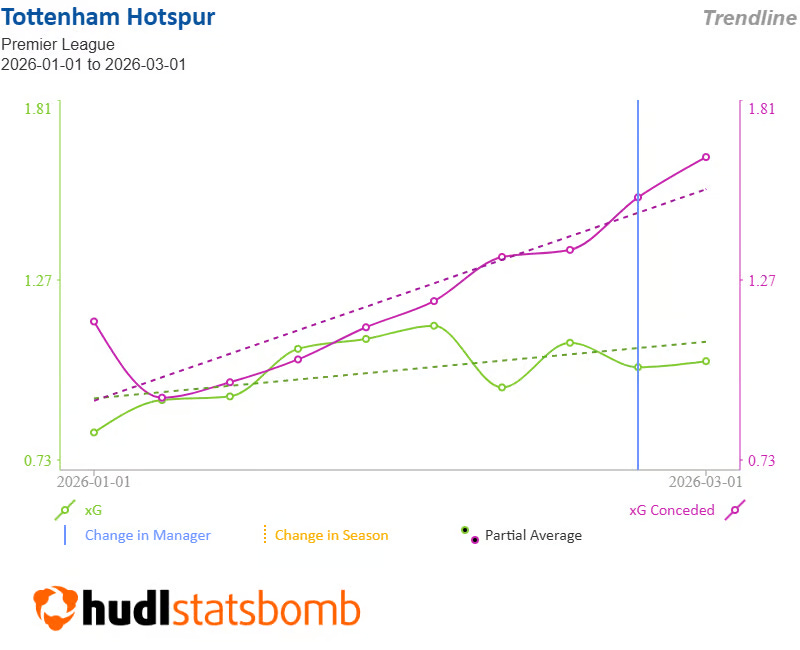
If you want to make the case for Spurs going down, you’re looking at bad form. They’ve lost all of their last six games, and the performances have been pretty rough. The graph below doesn’t include their last league match against Crystal Palace, but it tells a pretty clear story: Tottenham are conceding a lot more good chances than they’re creating right now. Keep playing like this, and they’re well in range for the drop. If you want to make the case Spurs will be safe, you’re relying more on the poor standard of teams around them than anything they’re actually doing themselves.
So how did this happen? There’s both a “what’s wrong with Spurs?” question here and a “why did the top six get softer?” question. For the latter, the most popular theory I’ve seen around is that “the rest” got better and richer. The baseline standard of opponent is higher now than it was a decade ago. I’m not totally sure I buy that. Those clubs are certainly richer than they were in the 2010s, but so are the top six. I honestly don’t know if the gap between rich and poor within the Premier League has grown or shrunk. It’s one for another day.
My personal pet theory, that ties both questions together, is that the big six got dumber while the rest of the league got more intelligent. At the start of the 2016-17 season, the big six employed the following managers:
Antonio Conte (Chelsea), Mauricio Pochettino (Tottenham), Pep Guardiola (Man City), Jürgen Klopp (Liverpool), Arsène Wenger (Arsenal), José Mourinho (Man Utd).
Everyone else, meanwhile, employed these coaches:
Ronald Koeman (Everton), Claude Puel (Southampton), Eddie Howe (Bournemouth), Tony Pulis (West Bromwich Albion), Slaven Bilić (West Ham), Claudio Ranieri (Leicester City), Mark Hughes (Stoke City), Alan Pardew (Crystal Palace), Francesco Guidolin (Swansea City), Sean Dyche (Burnley), Walter Mazzarri (Watford), Mike Phelan (Hull City), Aitor Karanka (Middlesbrough), David Moyes (Sunderland).
We can quibble about some of the names, but you would not have been insane if you claimed in 2016 that the first six names here were better than the next fourteen.
Now let’s look at the so-called “big six” managers right now:
Mikel Arteta (Arsenal), Pep Guardiola (Man City), Michael Carrick (Man Utd), Liam Rosenior (Chelsea), Arne Slot (Liverpool), Igor Tudor (Tottenham).
And “the rest”:
Unai Emery (Aston Villa), Keith Andrews (Brentford), David Moyes (Everton), Andoni Iraola (Bournemouth), Marco Silva (Fulham), Régis Le Bris (Sunderland), Eddie Howe (Newcastle United), Oliver Glasner (Crystal Palace), Fabian Hürzeler (Brighton and Hove Albion), Daniel Farke (Leeds United), Vítor Pereira (Nottingham Forest), Nuno Espírito Santo (West Ham), Scott Parker (Burnley), Rob Edwards (Wolves).
I don’t think we’re looking at close to the same talent gap. “The rest” have hired better coaches in some cases, but the biggest shift, I think, is the talent drain at the top. Guardiola is the same, while Arsenal have upgraded with Arteta instead of Wenger. But the other four? I think the vast majority would agree that Klopp and Pochettino are simply better football managers than Slot and Tudor. Carrick and Rosenior, meanwhile, may well prove to be excellent coaches, but they are punts compared to highly established figures Mourinho (who had won the Premier League as recently as 2014/15) and Conte. This is the visible change, but I feel like in some cases, we’ve seen a comparable decline in terms of squad quality and institutional structure. As the “best of the rest” started getting their act together, the “worst of the best” got awfully weak.
Yes, Spurs are the most extreme case of this.
If we look at Tottenham on the Euro Club Index (basically think FIFA rankings, but for European clubs), they reached their highest level in December 2018.
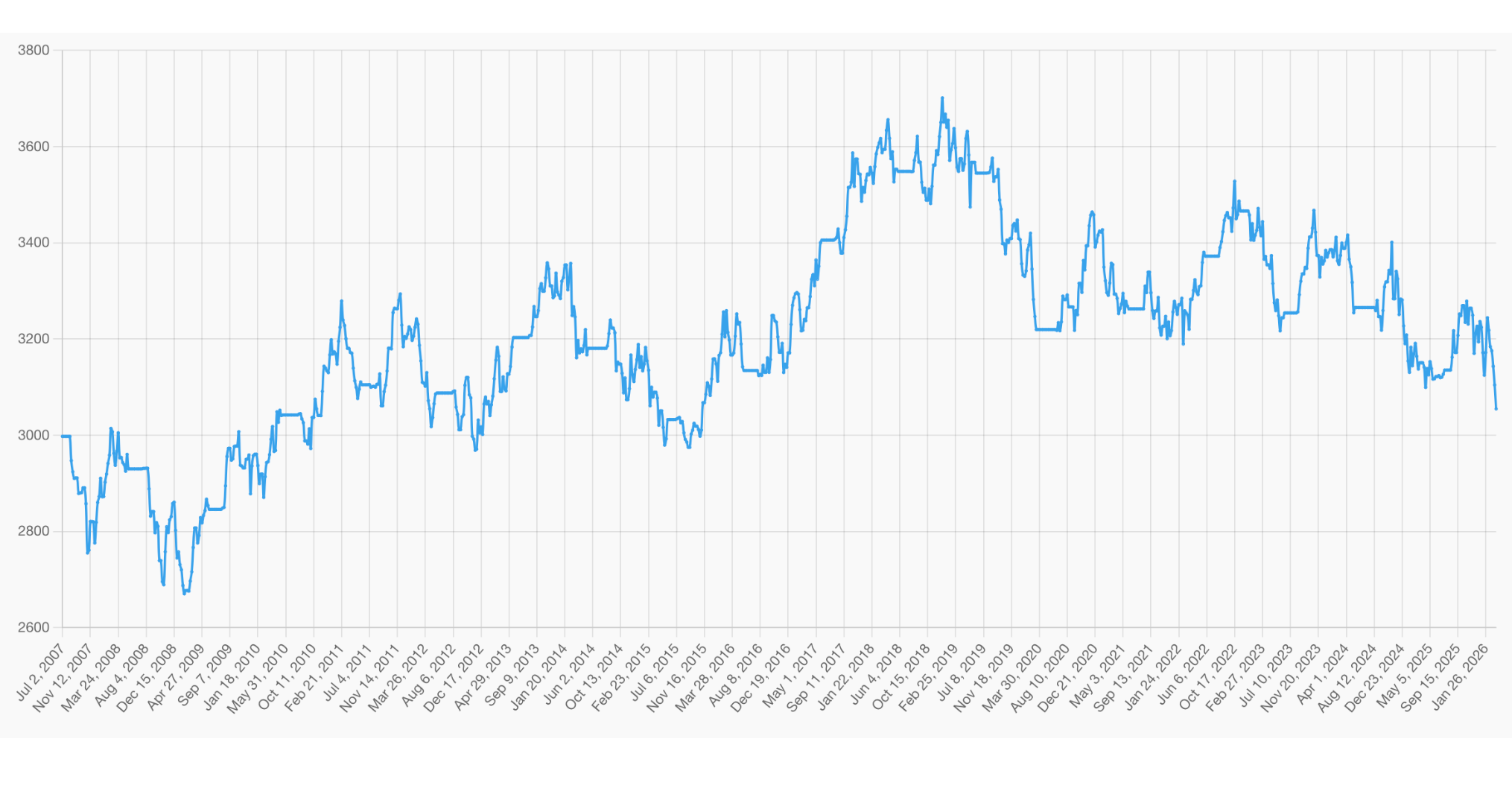
Pochettino was obviously the manager at the time. Their strongest eleven, I would say, looked like this:
Hugo Lloris (age 31), Kieran Trippier (27), Toby Alderweireld (29), Jan Vertonghen (31), Ben Davies (25), Eric Dier (24), Mousa Dembélé (31), Christian Eriksen (26), Dele Alli (22), Son Heung-min (26), Harry Kane (25).
Things got worse pretty quickly after that. Spurs reached the Champions League final in 2019, but their Premier League form had collapsed, winning just three of their last twelve matches. Dembélé had been sold in January, while Trippier went to Atlético Madrid in the summer. Pochettino was sacked in November. All it needed was some smartarse to claim this was obvious because nerd shite said their numbers had been trending down for a while. Thankfully, I was around at the time to point out their xG difference had been looking concerning for a little while and this had been a team clearly in need of a refresh.
Of that “strongest lineup”, the most recent signings were Son, Alderweireld and Dele, who had joined the club way back in summer 2015. Those three deals were all driven by head of recruitment Paul Mitchell, who came from Southampton alongside Pochettino but seemed to fall out with both the manager and chairman Daniel Levy, deciding to resign a year after he was appointed. Pochettino and Levy largely took control of transfers between them afterwards.
Spurs employed various different structures before this point, but were generally considered pretty sharp. “I think people get too hung up on job titles”, Levy claimed at one point. “In terms of how we run this club, whether a person is called director of football, sporting director, chief scout, head of recruitment, their job is ultimately to assist the manager in finding quality players. It doesn’t really matter what the title is”.1 That did seem to be the case for many years, with the rest of that “strongest” side (bar Kane, an academy graduate) getting bought through a mix of structures alongside managers Pochettino and predecessor André Villas-Boas2.
This was a club ahead of its time in embracing approaches now considered standard. Tottenham started employing the services of Decision Technology, driven by Ian Graham who would later work at Liverpool, as early as 2007. They were doing some impressive things that Liverpool would essentially copy with more money several years later. Levy took over as chairman of a midtable Premiership (as it was called back then) club in 2001 and oversaw their transformation into Champions League mainstays by the 2010s.
His most famous quality was both a huge strength and weakness: sacking the manager and changing everything. Football clubs, like many businesses, are often prone to sunk cost fallacy. Levy was never scared of just changing things if they weren’t working, which avoided wasting years heading down the wrong path but could also make it harder to build something. Pochettino seemed like the first manager he was entirely satisfied with in the dugout.
At the same time, his happiness with the manager meant ceding the recruitment infrastructure to Pochettino’s will. For all his good work, he never had any idea of how to sign players for the football he wanted to play. The summer 2016 signings were Moussa Sissoko, Victor Wanyama, Vincent Janssen and Georges-Kévin Nkoudou. Wanyama was pretty good, though obviously signed purely because Pochettino worked with him at Southampton. Sissoko ended up vaguely useful at times, but well short of the player Spurs seemed to think they were signing. Janssen did exactly the “scored loads in the Eredivisie” arc you’ve seen numerous times, while you probably forgot Nkoudou existed.
It continued like this the following year, with Davinson Sánchez proving a reasonable signing while Lucas Moura, Serge Aurier and Fernando Llorente never looked the part (shout out to Juan Foyth, who struggled here but did turn his career around somewhat at Villarreal). The following year, they signed… no one. I actually did really like all three of Tanguy Ndombélé, Giovani Lo Celso and Ryan Sessegnon at the time in 2019, but none worked out at all. Maybe Tottenham and I were both wrong, or maybe the team was suddenly a very difficult side to settle into, as the squad had decayed so much and Pochettino’s fatherly bond got replaced by Mourinho’s “good guys don’t win trophies” macho bullshit.
It seems ridiculous to say it, considering he was Tottenham’s best manager in my lifetime and the team continued to get excellent results for the next few seasons. And I certainly don’t think it’s the only wrong decision, or that it put them on an unavoidable path here. But if there’s a critical turning point for the club, the point when decisions from top to bottom went from “largely good” to “largely bad”, it’s the moment when Levy promoted Pochettino from Head Coach to Manager and gave him control of transfers after Mitchell resigned in summer 2016. Levy should’ve put his foot down and insisted on a continental structure, hiring someone who fit the forward-thinking model Spurs had at the time. Instead, the manager and the chairman became the entire club.
This was supposed to be the moment when Tottenham modernised. They were replacing the old White Hart Lane with a brand new stadium that could generate huge revenues with more fans at the games, more corporate hospitality facilities, and more major events outside of the kind of football you play with your feet. All of that was correct, but getting the ground built was always going to be a huge undertaking. With Levy focused on the stadium, he needed trusted hands to keep the football side ticking over. As it was, Pochettino took full control.
Once results started to slide, Levy inevitably reverted to type and sacked Pochettino, replacing him with whichever available manager most embodied the quality he was perceived to lack. I think Mourinho was the wrong choice for all the reasons we now know. But with Pochettino and his staff being the footballing infrastructure, Tottenham lacked the expertise to figure out where to go next. Levy, undoubtedly smart at running the business, just went with his gut and put Mourinho in charge.
Levy used to crave a director of football. “I decided there was something fundamentally wrong with the way clubs are structured in England”, he said in 2005. “The odd examples of stability, such as Manchester United and Arsenal, are the exception. I went on a fact-finding mission across Europe, and decided on a two-tier management structure, which is the norm on the Continent, with a sporting director working with a head coach.” The way this model is supposed to work is that the sporting director uses his relevant knowledge to hire (or at least recommend) the right manager. It’s a system designed to avoid exactly this outcome, but Levy had blown it up a few years earlier under the belief he’d found his own Sir Alex Ferguson.
Levy, as I said, was not afraid of changing things that didn’t work. Spurs were quicker than most to notice when Mourinho was dragging the club down and made the change after 17 months in charge. Once again, there was no plan and infrastructure. Levy decided he needed a sporting director but, in a situation that sums up the whole problem, Spurs didn’t have the footballing knowledge to find the right sporting director. Fabio Paratici, a man with a lot of trophies at Juventus but not a clear sense of how he did it, got the job for two years before “resigning” (with rumours he was still floating around in the background) due to getting banned from football over a false accounting scandal at Juventus. Yeah. Great infrastructure you’ve got there.
Paratici ran things in a very “who you know, not what you know” sort of way, even as his connections were much weaker in England than his native Italy. After Nuno Espírito Santo proved an immediate bust, Paratici turned to his former Juventus colleague Antonio Conte, obviously an excellent manager but an explosive personality to have in the room with Levy. Conte did what he does, overseeing an instant improvement in results before gradually wearing everyone down with his combative attitude. When Conte and Paratici were both (officially) gone in 2023, there was nothing substantive left from this Italian revolution.
Of the 17 players signed under Paratici, seven were from Serie A, including two from Juventus. Paratici was trying to operate the way Juventus operate without any of the specifics that made it work in Turin. You can’t build a Juventus model from the ground up because it relies on an awful lot of history and specific personal relationships. Juventus do not have a philosophy like Barcelona or Ajax, very proudly claiming that winning trophies is “the only thing that counts”. There isn’t a “Juventus model” that clubs can copy and build elsewhere. When Paratici got banned, all he had to take credit for were some mediocre signings.
Johan Lange, formerly of Aston Villa and Copenhagen, was hired as “technical director” in 2023, with Paratici still vaguely involved. The manager by now was Ange Postecoglou, trying to implement a more progressive style of football with a squad built out of patchwork approaches. Spurs’ transfer work shifted towards the domestic market, with some of the costly mistakes you can make if you buy English. Postecoglou probably got hamstrung by being very set in his ways in terms of how he wanted to play without the squad to suit, but the recruitment didn’t seem to be actively addressing this. It never felt joined up. It never felt like a football club, but rather a collection of individuals running different departments.
Postecoglou’s sunshine football didn’t take so, once again, Spurs completely reverted with a “pragmatic” manager in Thomas Frank, even though he also demanded a specific style of play that Tottenham didn’t have the squad for. I do think Frank was very unfortunate with injuries, but so too did he play an unsuited style. There has not been any kind of cohesive vision of what Tottenham should be, across recruitment and coaching, in over a decade at this point. It’s produced a group of disparate, disinterested, and some-other-word-beginning-with-dis players. Let’s go with disorganised, sure, that sort of works.
At the same time, Spurs have arguably smashed it on the business side. They were a midtable club in every sense when Levy took over, and he built solidly “big six” revenues while keeping the spending and wage structure under control. He locked in potential for even more revenue growth with the new stadium, surely his most important achievement. But all of that growth was ultimately set in place by good performances on the pitch. Spurs got rich by getting good. They will not be anywhere near being one of the six highest revenue clubs in the country if they get relegated.
Levy got forced out of Tottenham in September by the people who ultimately own most of the club, the “Joe Lewis family trust” (definitely not Joe Lewis himself). This was probably inevitable towards the end. Levy hadn’t built any sort of serious infrastructure behind him, and he ran on a “sack someone if results are poor” model. As Qui-Gon Jinn would say, there’s always a bigger fish, and the Lewis family decided to sack Levy for poor results this time. They obviously wanted something resembling a modern football structure but hired Vinai Venkatesham, formerly of Arsenal, as the CEO above Lange and Paratici as joint sporting directors. This all feels very agent-led and very clash of cultures.
So we have Igor Tudor parachuted in and possibly parachuted out pretty soon. There’s just no plan. All of this could’ve been avoided many times, but the path was set by a reactive structure. Levy’s greatest strength became Spurs’ greatest weakness. The Tottenham Hotspur Stadium built on the sand.
Spurs should probably survive. I don’t know where they go from there. Obviously, they need to develop a credible long-term plan, but I don’t know what that looks like. I don’t know what a reasonable timeline is for them to be challenging for Champions League football again. I don’t know anything, which is exactly the sort of quality analysis you come to this newsletter for.
I just know this is a shitshow that needs to change.
As mentioned in the book “The Club” by Joshua Robinson and Jonathan Clegg
I’m only counting permanent managers. Sorry, Tim.
So interesting to see somebody else (before the weekend results) has Spurs as only 10% to go down. I had 15% (now just below that) and assumed I was doing something wrong looking at the implied probabilities, even de-vigged!