

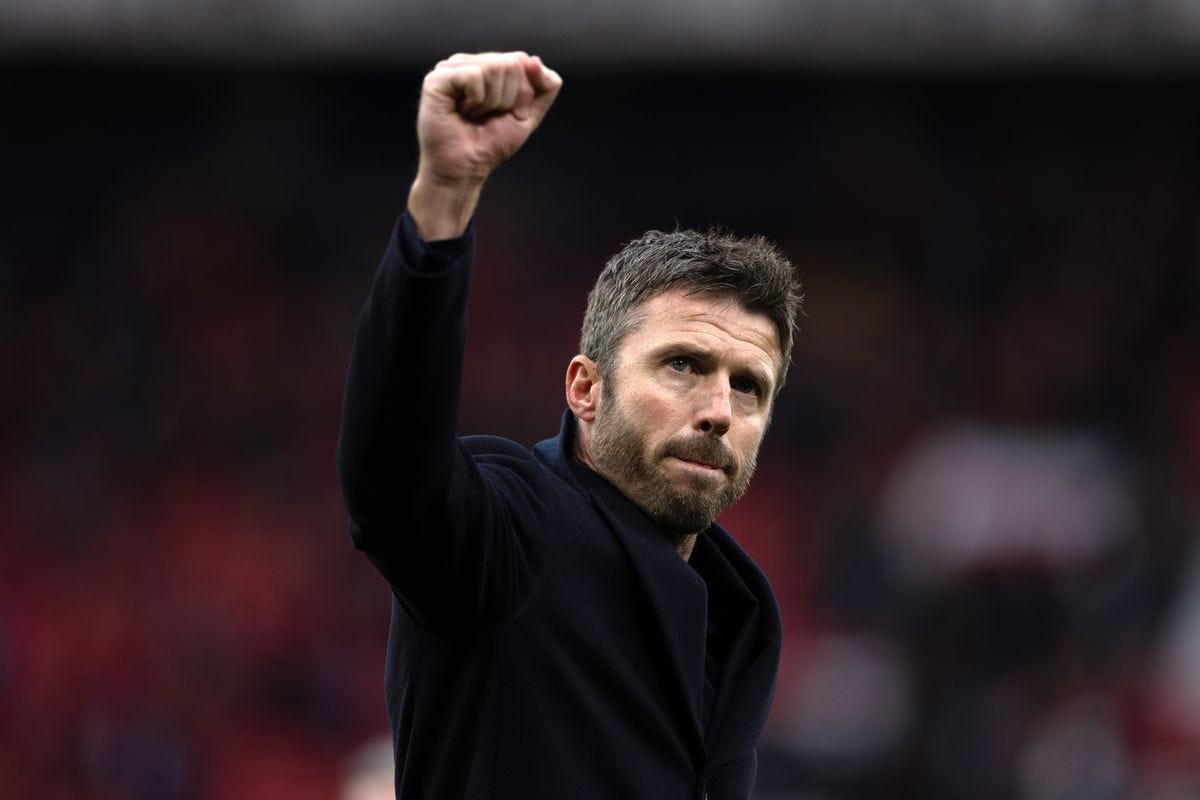
“I’ve heard people saying, “We need Michael to play to keep the ball”. However, when I did play, these same people were saying all I do is pass sideways. They demand eye-catching actions and moan when you keep the ball for a spell because ‘it’s not the English way’. We played in straight lines over the years — 4-4-2 with no fluidity — and found it very difficult to control games in possession.”
— Michael Carrick, on his time in the England national team
Michael Carrick was always different. He was the exception that proved the rule.
For Alex Ferguson, he solved a long-running tactical issue. Manchester United won the treble in 1999 playing a classically British 4-4-2 system, making them surely the last great side to employ that version of those tactics. Things changed straight away after that. They had four excellent midfielders in David Beckham, Roy Keane, Paul Scholes and Ryan Giggs, but European sides were putting a third man in the middle and outnumbering United in Champions League knockout ties. Ferguson accepted his team had to change in 2001, when he spent big on Juan Sebastián Verón and started playing Scholes or Giggs as a number ten behind Ruud van Nistelrooy.
That didn’t work, partly because Verón didn’t adapt to United and partly because the other players didn’t adapt to Verón. He was sold two years later, but the problem didn’t go away. It got worse because it wasn’t just European clubs doing it anymore. Chelsea, under José Mourinho, won back-to-back Premier League titles, flummoxing every British manager with the radical continental tactic of playing a 4-3-3. Yes, this is literally what happened. It wasn’t this country’s finest hour. Ferguson decided he needed a different sort of central midfielder, someone who could pass the ball and dictate tempo without being the wrong side of 30. So he signed Carrick.
This was, by any measure, a brilliant signing. United won the Premier League for the next three seasons in a row, with Carrick starting regularly. They lifted the Champions League in 2007/08, as Carrick started 11 of 13 games in that tournament, including every match from the quarter finals onwards. Carrick was a huge part of that team’s success.
Carrick was, famously, beloved by some big names. Pep Guardiola called him “one of the best holding midfielders I've ever seen in my life by far”. "I've always seen myself in him”, said Xabi Alonso. “He could play in the Spain national team”. That was felt internally. “The team-mates around him had huge appreciation for him”, according to Gary Neville. “He made everybody play better”. But it was not felt by the general public. “Even amongst my friends and even when we were winning leagues”, Neville claimed, “there were challenges to convince people about how good a player Michael was, and how important he was to the team”.
Carrick was, to the median British football fan in the late 2000s and early 2010s, “shite”. He didn’t run. He didn’t tackle. He didn’t score or assist goals. He just passed the ball sideways. Fans didn’t really understand what a player like that was adding to a team. We talk about him today in conversation with Steven Gerrard and Frank Lampard, but you’d have been laughed out of the pub for saying so at the time. A lot of United fans preferred Darren Fletcher or even Anderson. At least they could run. This country is not programmed to value someone who gains value for the team by passing the ball and making quiet interceptions. Carrick felt lab-built to do everything we don’t value.