

Happy New Year, everyone! Today, we’re starting a brand new series that will run occasionally in the run up to the World Cup this summer. It’s going to be looking at teams that were widely expected to be serious contenders in previous tournaments but, for whatever reason, it just didn’t happen at all. What went wrong? What are the key takeaways? Can we learn important things about how sides should approach the World Cup? I think these failures should tell us just as much as the success stories. The first one, on France in 2002, is free to read. Subsequent editions will be paywalled.
France were hot as shit heading into the 2002 World Cup.
For the second time ever, a single country became the reigning champions of both the World Cup and their continent’s major trophy. France lifted the World Cup trophy on their home soil in 1998 (which I wrote about previously), then really established a new hierarchy by winning Euro 2000 in Belgium and the Netherlands (not exactly the longest trek, yes).
Manager Aimé Jacquet stepped down after the 98 victory to be replaced by his assistant, Roger Lemerre. Unsurprisingly, Lemerre largely stuck by Jacquet’s players in 2000 with pretty minor tweaks. All of the starting eleven that won the Euro 2000 final – Fabien Barthez, Lilian Thuram, Marcel Desailly, Laurent Blanc, Bixente Lizarazu, Didier Deschamps, Patrick Vieira, Youri Djorkaeff, Zinedine Zidane, Thierry Henry and Christophe Dugarry – started at least once at the ‘98 World Cup. It’s not like Lemerre didn’t have options. David Trezeguet and Sylvain Wiltord were surely more exciting attackers than Dugarry by this point. In fairness, Lemerre had largely used Nicolas Anelka upfront during the tournament, but poor form meant he opted for a tried-and-trusted Dugarry for the final. The system worked. France won while playing better football than they had at the World Cup two years earlier. They added the Confederations Cup in 2001 with a heavily rotated squad, cementing their status on top of the world.
All of this led to Lemerre making an understandable but catastrophic error in 2002: he stuck with the players who had won in the past, ignoring the sands of time. I think this will be a familiar theme in the series as we go through teams that messed up.
Barthez was playing for Manchester United by 2002 and, while his form wasn’t quite perfect, he was pretty unanimously France’s number one goalkeeper at age 30. The news gets worse from here, as Lemerre stuck with a back four of Thuram, Desailly, Frank Leboeuf (long a deputy for the now-retired Blanc) and Lizarazu. Thuram, 30, was starting regularly for Serie A title-winning Juventus, so it’s hard to argue too much with him on paper. Desailly was captain but, at 33 years old, Chelsea were already phasing him out for John Terry and William Gallas (who didn’t even make the French squad). That’s at least better than Leboeuf, 34, who Chelsea had sold to Marseille a year earlier. Lizarazu was still an important player for Bayern at age 32, but that’s an entire back four over thirty.
Deschamps, arguably France’s best performer in ‘98, did his country a huge favour in that he had already retired from football by 2002, forcing Lemerre to freshen up the midfield. At age 25, Vieira was considered one of the best players in the Premier League, making him an easy pick. Emmanuel Petit, 31, had spent three years forming an excellent partnership with Vieira at Arsenal, even if he left the Gunners in 2000 and now meant another older player in the side.
When you think about France in the late ‘90s and early 2000s, chances are the first player who comes to mind is Zidane. He was a national icon going way beyond football in France. He set a new record for the most expensive player in history in 2001, when hotshot Florentino Pérez made him a centrepiece of the galácticos project at Real Madrid. At Euro 2000, he delivered on the hype, dominating the tournament with a much better performance than his inconsistent ‘98 World Cup. He was everything, and he was injured in a warm-up match. Zidane still made the squad, but he would be unavailable for the first two games, forcing a rethink. An obvious understudy, Robert Pires, also missed the tournament through injury.
Lemerre did exactly what you’d expect him to do and started a trusted veteran, Djorkaeff, at number ten. Djorkaeff obviously had a great career, but he was 34 years old and playing for Sam Allardyce’s Bolton Wanderers. It is what it is.
That’s the “slow” part of the team out of the way. Now we can talk about the “fast” part. Wiltord, 28, preferred to play upfront but was very accustomed to starting on the right wing for Arsenal, which made him an easy pick here. At age 24, Henry had come into his ludicrous peak for Arsenal and was probably the best player in the squad at this time (yes, even including a fully fit Zidane, I said what I said). He was the focal point for everything at Arsenal, playing as the lone striker but with the freedom to drift wide.
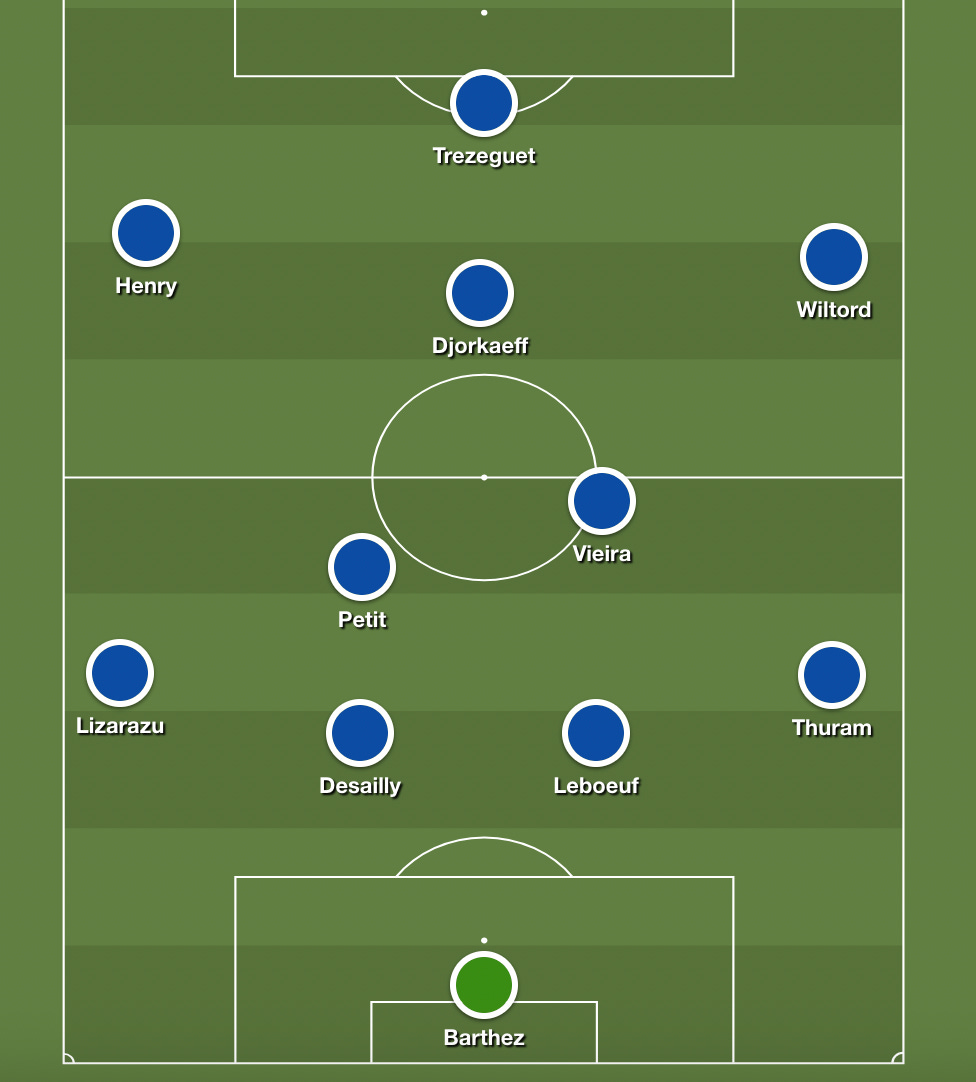
That could never happen with France because of Trezeguet, also 24, who was looking electric upfront for Juventus. Matching their ages, each had scored 24 goals in the Premier League and Serie A that season. It’s a very nice problem to have, but fitting them in together was always going to be a puzzle. For everything else they had, France rarely produced “proper” wingers in this era, relying more on converted forwards and creative midfielders. There wasn’t a quality left winger in this squad, which means Henry paid for his versatility. He started out wide while Trezeguet got the plum spot as the striker. The shape of the team was a pretty conventional 4-2-3-1 without too many complications.
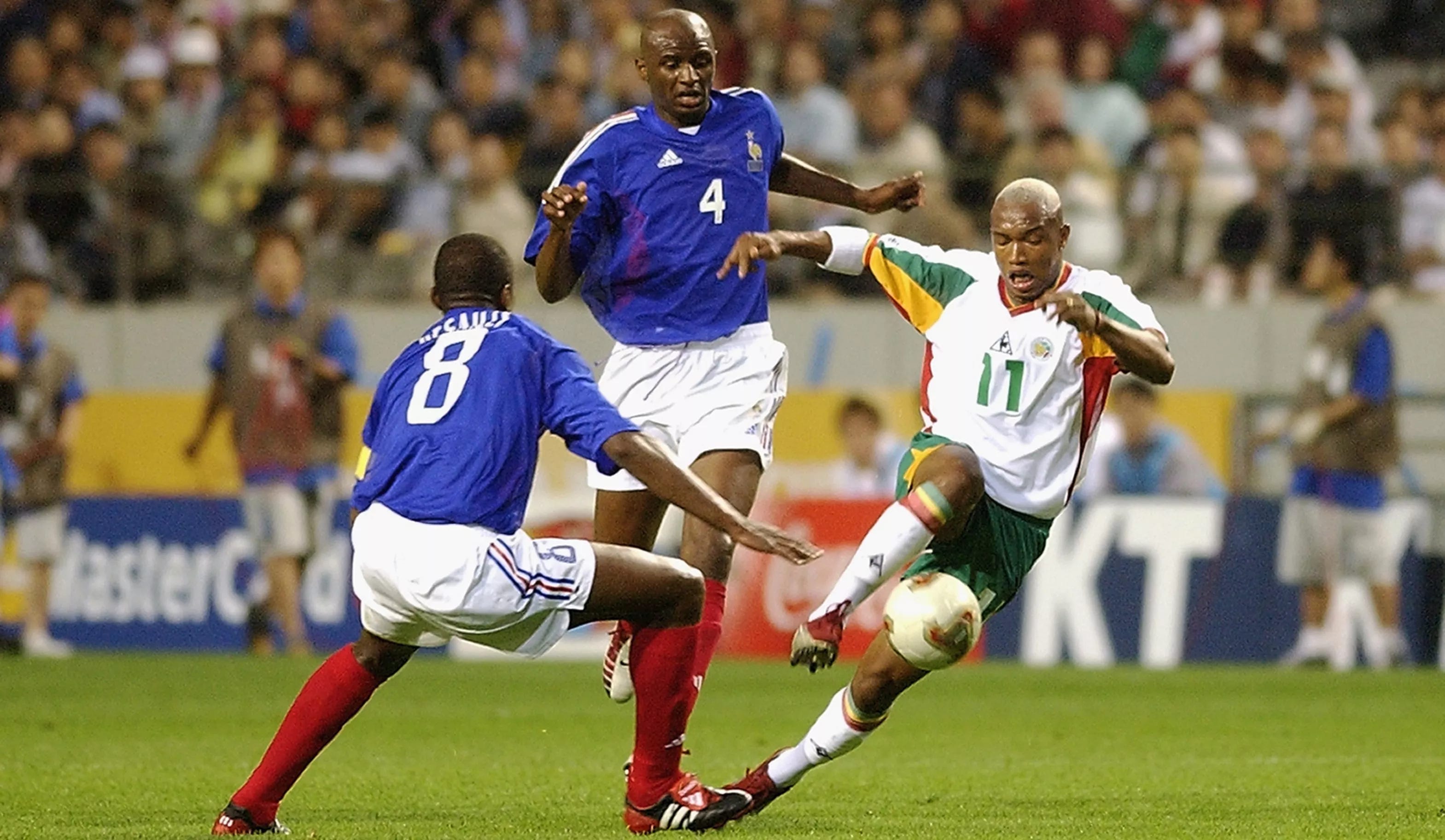
They were facing Senegal in their opening game. This was always going to be politically charged as Senegal is, after all, a former French colony. But it was particularly resonant in this moment. The French won the previous World Cup with a team celebrated for its ethnic diversity. “Black, Blanc, Beur” (Black, White, Arab) became a slogan coined to celebrate these players from different backgrounds all coming together to produce something truly “French”. It’s one thing to celebrate this in the context of French national identity, but it’s another to look at it through the lens of a country France once colonised. There were a lot of players developed in France with ties to West African nations. Desailly, for example, was born in Ghana before moving to Northern France at age four.
More relevant for this game would be Vieira, Senegal-born but France-raised. This kind of story would actually be much more common in the opposing camp. All but two of Senegal’s squad played their club football in France. Suddenly, France’s diverse inclusion became a colonialist sneer: Senegal could be dismissed as “France B”. Surely any of these players would’ve followed Vieira’s path to Les Bleus had they been “good enough” for France. In truth, most of the Senegal squad moved to Europe in their teenage years, and I have no idea how many would’ve theoretically been eligible to play for the French. But the narrative was set. People from all of France’s former colonies are welcome and embraced, so long as they advance the interests of the white Frenchman. The Senegal players were the “bad” immigrants, not respecting the proper order of how things simply must be. Are they not grateful or all that France has done to for them!?
Senegal’s strategy was obvious from the start: sit back, let France have the ball, then get El Hadji Diouf running at those older defenders on the counter. They’d very frequently have everyone but Diouf in their own half, behind the ball. They exposed the threat pretty early on, when Diouf caught Lizarazu unaware to blitz past him, dragging Desailly wide before beating him on the dribble and putting in a cross for a decent chance. It might be hard to believe in light of his later career, but at 21 years old, Diouf was electric in this Senegal team, and exactly the type of attacker those French defenders didn’t want to face.
It shouldn’t have been this easy to frustrate France with a low block, but their lineup felt almost lab-built to suffer here. As wingers go, Henry and Wiltord weren’t really the type to get chalk on their boots and put crosses in. They wanted to run in behind. That made it easy for Senegal to stay deep and compact, leaving all the space out wide. Henry especially struggled with this, as the positions he took up were too narrow to cause any problems (understandable, considering how he played for Arsenal at the time). This meant both full backs had to push higher up the pitch to offer genuine width, making France easier to expose on the break. Honestly, Senegal weren’t brilliant at this. There were a few moments where they got undone by poor organisation, and France had a chance straight down the middle. It just really spoke to a lack of ideas that the French couldn’t make this happen more often.
And then, half an hour in, the moment. Djorkaeff is too casual on the ball trying to do some clever but useless trick or something on the halfway line, allowing Senegal left back Omar Daf to win the ball off him.
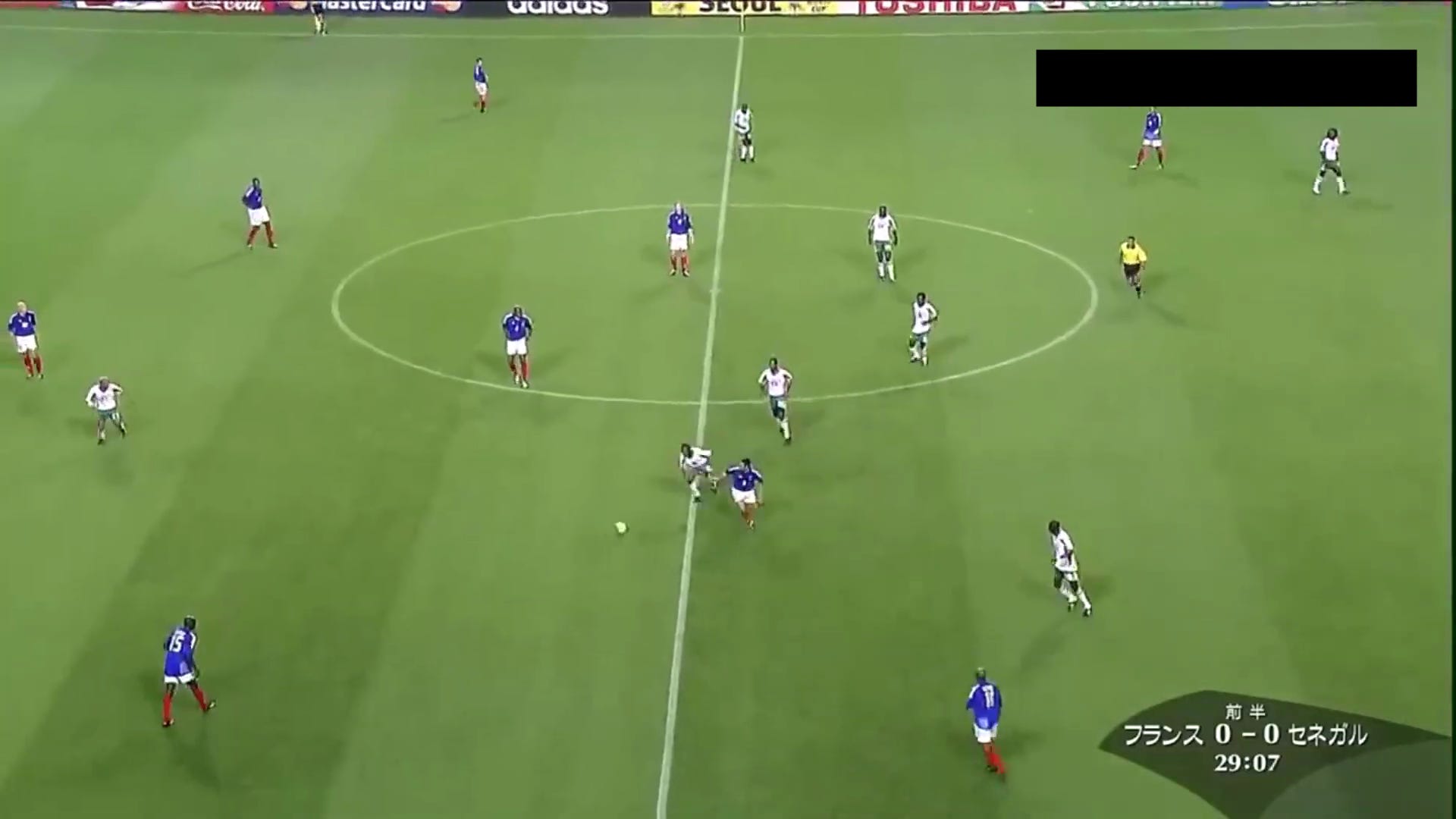
Daf then passes it straight to Diouf attacking France’s right side. Thuram has been caught up the pitch, forcing Leboeuf to come wide and leaving France looking pretty open.
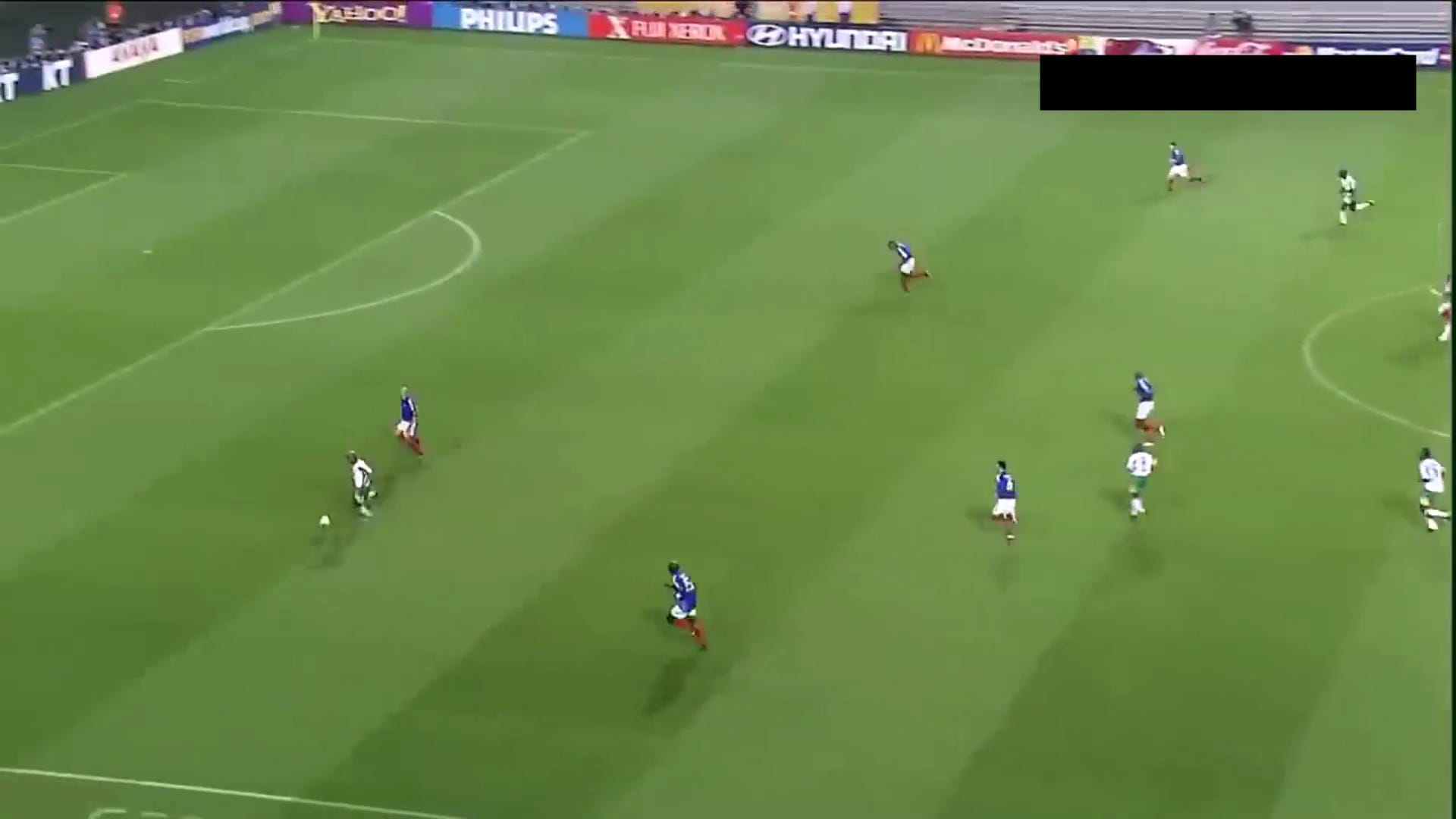
Diouf dribbles past Leboeuf with ease, but he then makes a poor decision, going towards the byline instead of cutting inside and getting a 1-v-1 with Barthez. As it was, he had to put a cross in for one Senegal player against six Frenchmen.
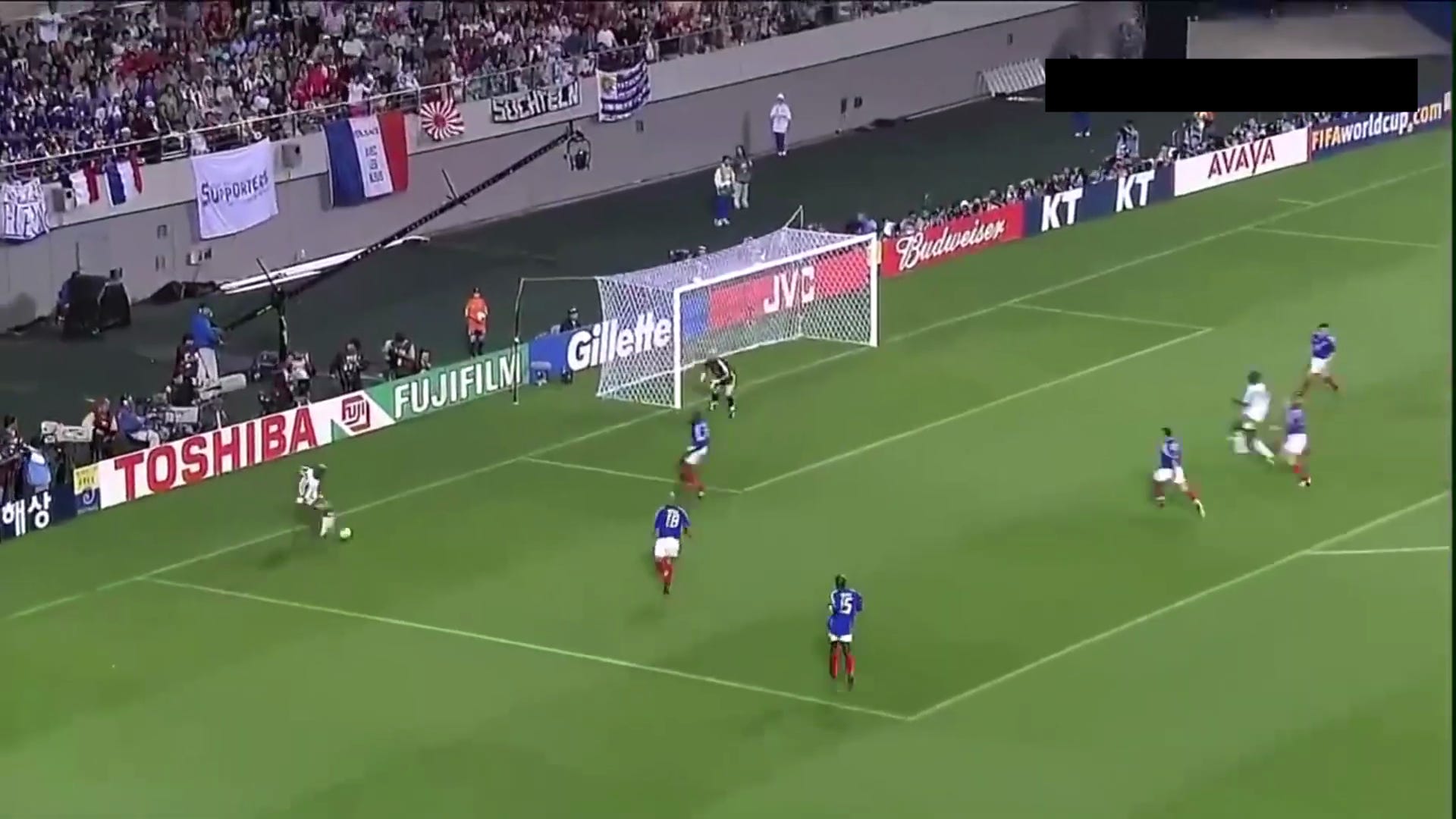
I can’t quite get a good image for this, but Diouf puts in a scruffy ball that France do a dreadful job of defending. Petit gets in the way of the cross and sends it straight to Barthez, who spills it only for Papa Bouba Diop to get a tap in. It’s one thing to get undone by pace. It’s quite another for defenders with this much experience to fail at the basic task of stopping one man in their own box.
If you’ve watched literally any football in your life, you can guess what happened next. Senegal sat even deeper to protect their lead, while France threw more and more at it to try and get a goal. But I’m not sure France had a great idea for how to do this. Djorkaeff came off for Dugarry after an hour, with Lemerre going for the old “throw on another striker” trick that definitely always works. Dugarry played on the left, with Henry now partnering Trezeguet upfront in a 4-4-2. It really speaks to how short France were of genuine wide players that this was the only move to get Henry in the box. He came close to producing one of those moments of magic he so often delivered at Arsenal in this era when he hit the bar from outside the box, but it wasn’t quite enough. Henry was clearly the team’s biggest threat once moved upfront. It suddenly felt like even more of a waste that he started on the left.
France were better in the second half. The change of shape, as well as tiring Senegalese legs, helped them find more space. I don’t think Senegal were particularly impressive here. Their approach was pretty obvious, but they weren’t as defensively organised as they could be. France probably could’ve found an equaliser in the second half, though I don’t think this was a huge injustice. They didn’t have the solutions. The team’s lack of genuine width was a huge problem that Senegal pretty easily exploited.
Lemerre’s last throw of the dice was to bring on Djibril Cissé for Wiltord. I don’t quite understand the thinking here beyond “Cissé scored lots of goals this season”. He’s not really suited to stretching the play as a winger, and there were already three natural strikers on the pitch. Cissé ended up taking positions that were too narrow for what France needed, and he didn’t have any impact in his ten minutes on the pitch. That was that. Senegal got their famous win, and as much as I love to be a contrarian, France didn’t do enough to argue it was unfair.
Lemerre made just one change for the second match against Uruguay: Johan Micoud in for Djorkaeff. I don’t think anyone could argue with that, but it seemed a bit minimal. I would’ve at least changed the back four a little bit, but Lemerre clearly disagreed. The shape and approach was unchanged. Uruguay had a tough run of qualifying for this World Cup, having to go through the intercontinental play-off after just scraping fifth place in the South American qualification. They finished level on points with sixth-placed Colombia, needing to rely on goal difference. For a fan of European club football, Uruguay’s biggest star at the time was Álvaro Recoba, the number ten then of Inter Milan aged 26. The most familiar name to modern eyes, Diego Forlán, had not yet established himself and sat on the bench.
Leboeuf picked up an injury after 16 minutes to be replaced by Vincent Candela, a natural right back forcing Thuram to move to his preferred (but less often seen) centre back spot. I don’t know why Candela didn’t just start after Leboeuf’s stinker against Senegal. The start of the game was really open, with chances for both teams and neither system able to really shut down the opponent. Uruguay left a lot more space in behind for France to exploit than Senegal did.
Henry tried to win the ball back to launch a fast counter after 24 minutes, but did so with the sort of “striker who doesn’t know how to tackle” challenge. He flew in on Marcelo Romero and got himself a straight red card. That was his World Cup finished, not that he knew it at the time. France, meanwhile, were already coming under pressure from Uruguay’s attack. Unsurprisingly, Micoud moved to the left and France played a 4-4-1 shape.
France’s overall approach didn’t really change that much with ten men. They still wanted to win the game and tried to do so. Uruguay played a narrow system and dominated central areas with their intricate build-up play, whereas France used width and long balls up to Trezeguet. Uruguay really started to exert control on the game during the second half, but France still had real chances. It was a very entertaining 0-0, but one that France should’ve been pleased to get out of alive. Henry was an idiot for getting sent off, but otherwise I don’t think France were poor with ten men against a good side.
They needed to beat Denmark and overturn a goal difference deficit, while also hoping the other game went their way. Denmark had beaten Uruguay before drawing against Senegal. This was not a vintage Danish team, obvious to everyone after an abysmal showing at Euro 2000. A front three of Dennis Rommedahl, Martin Jørgensen and Jon Dahl Tomasson could cause problems, but France were obviously the more talented side. A draw would’ve been enough to see Denmark qualify.
It would take a lot to get France into the knockouts. But anything was possible. France could dream. They could dream because Zidane was back.
Leboeuf presumably still wasn’t fit enough to play, so Thuram continued at centre back with Candela at right back. Claude Makélélé replaced Petit in midfield. This was because Petit picked up a suspension from consecutive yellows, and yet I wonder why a player of Makélélé’s quality wasn’t starting the whole time. Henry was now suspended, so makeshift winger Dugarry played on the left. Zidane, obviously, took over from Micoud in the number ten role. France were otherwise as they were
France started pretty well. Zidane helped early on, as the side had a much better way of progressing the ball through the midfield. But it was actually a counter attack, when Denmark sloppily gave the ball away, that saw Wiltord through on goal before sending the side’s best chance of the tournament so far straight into the goalkeeper’s hands. Zidane then miscontrolled a brilliant chance in the box after Vieira played a really good clipped ball over the top. This was better, though. This felt like a real football team.
And then.
Denmark put a long throw in France’s box that Vieira heads “away”, before it lands straight back into danger and he has to clear it with his feet. He makes a terrible clearance straight to a Denmark shirt on the edge of the box. Denmark then float in a cross to Rommedahl, who at the back post just near a completely unaware Candela. Again, you expect this team to get undone by speedy forwards. You don’t expect them to fail at basic defensive jobs like a full back switching off.
And yet France kept playing good stuff. They created more chances in the first half than the previous two games combined. This was fluid, entertaining stuff. Zidane, and a lack of Henry, gave the team a much better balance. I don’t agree at all with the view that he looked short of match fitness here. He was the best player on the pitch in the first 45 minutes. The ball just didn’t cross the line.
Dugarry picked up a knock and Lemerre, with a sense of “fucking hell, we need a goal here”, brought on Cissé. I understand the panic, but Cissé recreates the same tactical problems Henry caused in previous games, except with a significantly worse player. But maybe I’m just seeing Cissé’s subsequent career and not the promising youngster in 2002. I still think it would’ve tactically made more sense to bring on Micoud.
France had played really good attacking football in this game. They were clearly the better side throughout. And yet that still meant nothing because football loves a punchline. They just got undone so easily by a pass straight through the heart of the team from Thomas Gravesen to Jesper Grønkjær, who squares it pretty easily for Tomasson to score a tap in. France created so many good chances here but they could get undone this simply. They admirably kept trying to score a goal, but it was over. France were going home.
I don’t think France were quite as poor as “three games, one point, zero goals”, but they can’t really argue they deserved to get out of this group. As far as I’m concerned, there were two main issues here.
The first is injuries. Zidane made the whole attack click so much better in the third game and would’ve obviously been a huge asset against Senegal and Uruguay. The attack needed someone who could slow down the play instead of wanting to run in behind at pace. Pires would’ve also brought this, along with the added benefit of not having to play Henry on the left (even as that meant dropping one of him or Trezeguet). The side was just unbalanced in attack.
The second, and less forgiveable, issue was trusting in the old guard. Neither Leboeuf nor Desailly should’ve been starting games at this point. Mikaël Silvestre was not a defender of their quality, but he could run, and that alone would’ve solved issues were he next to Thuram at the heart of defence. Starting Djorkaeff against Senegal was silly. I know it’s hard to perform that cultural reset, to say “thanks for everything you’ve done, but it’s time to move on”. I’m pretty sure that’s going to come up again in this series.
Lemerre’s successor, Jacques Santini, didn’t fare that much better at Euro 2004. He played an interesting system with Zidane narrow on the left and Henry partnering Trezeguet in a sort of 4-4-2. Ideas were there, but they came unstuck against that Greece team man-marking their way to glory. Things were better in 2006, when enough fresh faces helped the veterans reach the World Cup final before Zidane… you know. It happens.
Next time: Brazil, 2006 World Cup
You have, as always, so eloquently explained how and why it happened. But it still blows me away that this France team had the reigning Golden Boot winners for England (Henry), Italy (Trezeguet) and France (Cissé), as well as Zidane a month after the peak of his club career with THAT goal in the 2002 Champions League Final, and this is the one that flames out. Incredible, honestly.
I love these retrospective pieces you do especially about international soccer, Grace!Looking forward to others to follow!