
Where does the power lie in football?

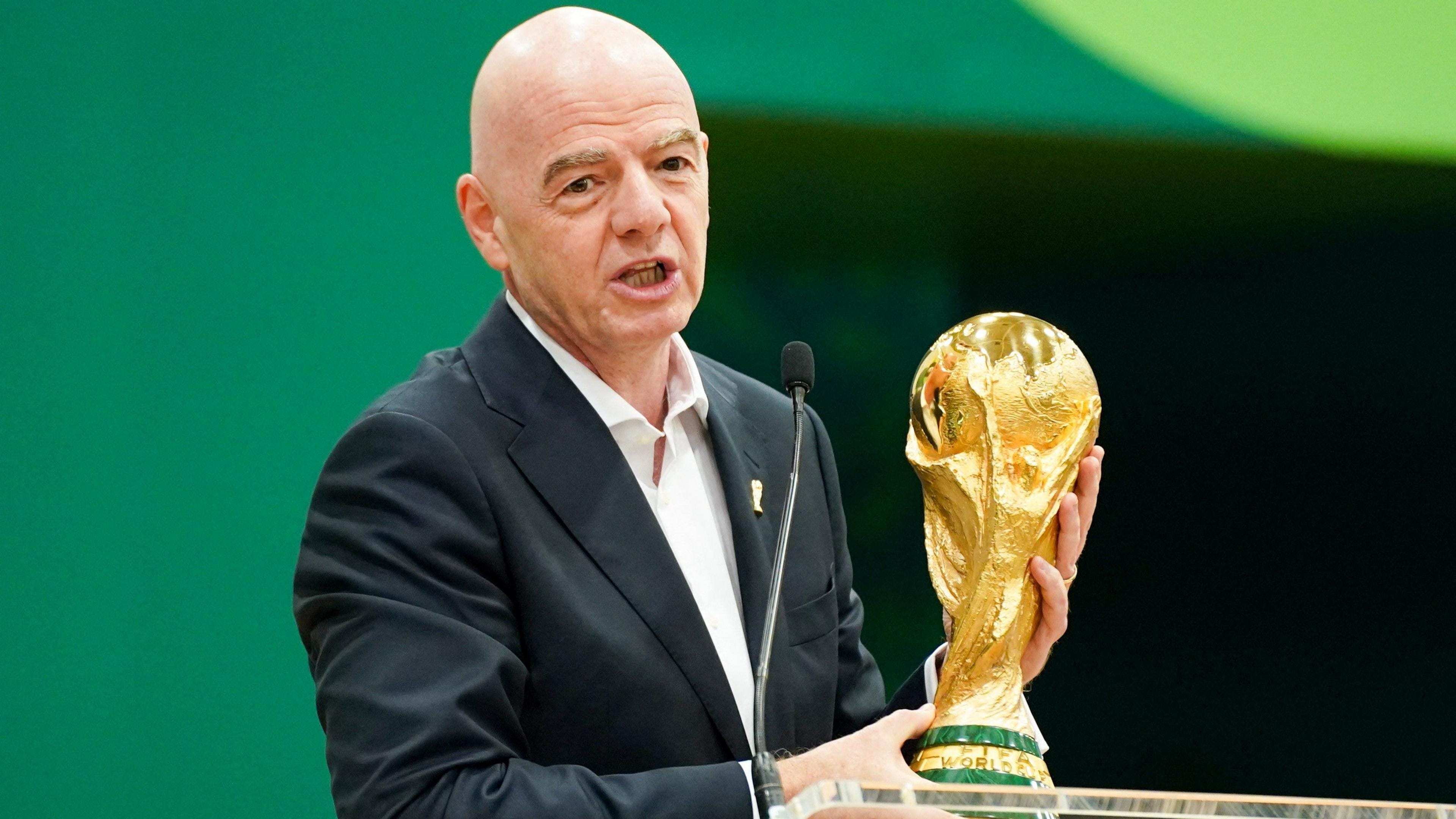
For as long as I can remember, FIFA has operated under one basic assumption: the first job is to win over the smaller member associations.
The logic behind this thinking was that major decisions are done on a “one member, one vote” system, meaning that a smaller nation can wield the same power as a bigger one. The key to a FIFA presidential election, therefore, is in winning over the smaller members. In practice, there’s a cheat code to doing this. These smaller associations tend not to be flowing with cash, so money from FIFA (be it for legitimate aims or… I’ll let you imagine) tends to be highly valued.
It’s a very common way that corruption tends to flow in football. Take Brazil as an example. “One of the biggest problems of Brazilian football is its political structure”, Tim Vickery (the most respected English-language voice on football in Brazil) wrote in 2017. “The country is divided into 27 states. Each state has a football federation, and the balance of power inside the CBF (Brazilian FA) lies with these federations […] they are politically subservient to the federations, who base their power on the numerous tiny clubs within their domain. The federations have, in practise, turned into a tropical equivalent of the rotten boroughs of nineteenth century British politics, wielding power but representing no one and nothing beyond their own interests.”
Vickery makes a comparison to “rotten boroughs”, an old problem in the UK in which parliamentary constituencies could have very few living citizens because the boundaries were drawn such a long time ago, but the representatives of those boroughs carried the same voting weight. I’m sure some of you reading this thought of the US Senate, which even today runs a structure whereby every state from California (population 39 million) to Wyoming (population 600,000) gets two senators each, stacking the deck heavily in favour of smaller states’ interests. It’s how a lot of corruption happens in the world. Political structures can be slow to update when some members become much larger than others, causing a power imbalance that most people with the votes to change it are actively benefitting from. That’s how corruption often works.
But then there’s the opposite flavour of corruption. It’s the more famous kind: the one where the richest and most powerful rig the game in their favour. We see this one a lot in European club football. The Champions League has been gradually engineered to reduce the risk of the biggest names failing to qualify. It’s been 22 years since a club from outside Europe’s top five countries (Porto) won the tournament. The richest have done the same thing domestically. The Premier League has been built on greed to suck the rest of English football dry. The assumption has been that the big boys get their own way.
The Super League was the moment the second kind of corruption was challenged. The elite of the elite said, “we can do whatever we want, this is happening, deal with it”. The world said “no”. The Super League clubs significantly weakened their hand in the process. Supposed plans for the biggest names to get a backdoor “wildcard” Champions League entry even if they didn’t earn it on the pitch were shelved. The British government set up an independent regulator to keep an eye on football. They had to confront the reality that their power has limits.
FIFA, pioneers of the first kind of corruption, just had the same experience. Suddenly the power structures we knew aren’t quite as solid as we assumed.
Let’s circle back on how we got here.
FIFA president Gianni Infantino had set up plans to launch a new spin-off of the organisation, “FIFA Forward Enterprise”, that would take control of selling media rights and ticketing for all of FIFA’s events. It would function as a for-profit arm of the World Cup, while the rest of FIFA stuck to running football. FIFA itself would own 80% of the new company, with the remaining 20% being sold to private investors for £3.1 billion ($4.2 billion). We already knew that said 20% stake would be bought by Joshua Kushner’s VC firm Thrive Capital, with the White House connections Kushner obviously has. This money would then be spent on giving member associations £30 million ($40 million) each through various schemes. A bunch of articles were written on this and I’m just pulling from this one by the Athletic.
An important point, I think, is that the 20% would just be the start. FIFA would be free to sell off more. Inevitably, elections would come around when the president needed some cash to pitch a retail offer to voters. You can imagine a scenario where the World Cup becomes almost entirely owned by hedge funds and gulf state sovereign wealth, with FIFA retaining a small stake for administrative purposes.
Among Infantino’s core constituency, this was probably pretty popular. John Duerdin claims that “at least two-thirds” of Asian countries would’ve voted in favour of the proposal according to his source. I’m sure that was repeated in Africa, and honestly even parts of Europe. Some of the smaller UEFA nations might well have been interested here. But bloc politics ruled. UEFA’s footballing might relies on larger and richer nations who were strongly opposed to this.
For once, they got their way.
Of course they will dress this up as altruism. FIFA tried to do something obviously bad for the game, clearly motivated by greed, and the heroes in Europe put a stop to it. But realistically, this was driven by self-interest. UEFA have been fighting every new FIFA proposal for a while now because the two organisations’ interests do not align. They’re fighting over the same territory.
Demand for football probably isn’t going up as dramatically as it did during the 2000s and 2010s. The new audiences have, to an extent, been found. The Premier League’s domestic rights value isn’t growing nearly as quickly as it used to, with the league relying on international growth that will also plateau at some point. This is going to be the same story everywhere. There is a limit on demand for football.
From what I’ve heard people say, the view among some higher-ranking media broadcast people is that while demand is going to flatten, supply can keep going up, and that will justify revenue increases. This seems a little shaky to me, but whatever. The obvious limit is that supply is not an infinite resource here. Players can only play so many games. They’re playing too many as it is. The battle is not for new audiences but for the calendar. And that’s where FIFA and UEFA have really been going at it.
FIFA would like to have the men’s World Cup every two years. And in the off years, it would like to have the Club World Cup every two years. It would like to expand the World Cup to 64 teams and thus more games. It would like to devalue both the Champions League and the European Championships to boost its own competitions. We seem to be past the point of a rising tide lifting all boats. FIFA and UEFA are fighting over who gets the bigger slice of the pie rather than seeking to raise revenues across the board.
FIFA’s model of appealing to the less wealthy member associations has driven the assumption that they don’t really have to make big concessions to UEFA. I don’t think getting UEFA onboard with everything would make football better. It would probably mean things like more World Cup places for European teams specifically, and more deference to the European club calendar. Perhaps we’d see more World Cups hosted in Europe (which seems to happen about once every 12 years now, whereas more than half had been held over here before the turn of the millennium). FIFA do not engage with persuasion like this. Their model tends to be to use their power to try and force people to comply rather than sit down and strike a compromise.
This is why Infantino has been seemingly relaxed at UEFA’s growing frustrations. But the Europeans have decided to go nuclear here.
UEFA quickly opposed FIFA’s sale plans so strongly as to start a boycott. Even as the plans have been withdrawn, the boycott still holds. “UEFA’s associations were very clear about the conditions attached to the non-participation in FIFA competitions”, the organisation explained. “First, the proposals to sell off the major competitions had to be withdrawn and secondly, assurances have to be made that such attempts to disfigure the game in this way will never be made again.
“These conditions have not been met. In addition, UEFA made it abundantly clear in its statement on Saturday that it has lost confidence in Gianni Infantino’s presidency. That position holds.”
The next FIFA tournament on the calendar is the Under-20 Women’s World Cup in a month’s time. It would be brutal for the players expecting to be involved, but I don’t think UEFA would lose a huge amount of money or credibility for skipping this one, even if it is to be played in Poland. The tournament itself would probably see atrocious ticket sales and bad PR if the host nation and host continent did not play. Sitting this one out could be an obvious way for UEFA to point score. After that comes the men’s Under-17 World Cup in Qatar. Again, this is a good one to use as a rhetorical stick since the host nation has already been a point of contention in European football circles. It’s interesting to watch because Nasser Al-Khelaifi, the chairman of Paris Saint-Germain and the face of Qatari interests in European football, is on the UEFA executive committee. But so are some fierce FIFA critics, like the Norwegian FA’s Lise Klaveness.
The much more charged question is: what happens at the senior Women’s World Cup in Brazil next summer? There are real stakes involved here. UEFA would almost certainly see a lot of criticism and internal frustration for boycotting that tournament. Many would reasonably condemn the confederation for using the Women’s World Cup to make their point in a way that they would never do with the men’s tournament. But the evolving UEFA position seems to be just that: Infantino must go, then we’ll talk.
FIFA has already agreed broadcasting deals around the world for that tournament and might have a lot of lawsuits on their hands if European teams don’t turn up next June. UEFA has real leverage here. They are also up against a coalition that actively wants to keep a status quo against European interests. But UEFA can easily derail entire plans because so much of the interest in football depends on Europe. What is the Club World Cup worth without the European teams? The entire appeal is in seeing the best from elsewhere take them on. What is the value in the World Cup without Europe? Everyone puts an asterisk next to the women’s tournament winners next summer if the boycott remains. UEFA believe FIFA’s voting coalition is about redistributing money that Europe generates. If so, UEFA can pick the ball up and go home.
I guess we’ll have to wait and see what happens.