World Cup: Day 13

Feel free to skip this section if you don’t care, but before we get into the games, I wanted to talk a little about something that’s been on my mind: British TV coverage of this World Cup. Yes, I know the majority of you don’t live in the UK, but this is my newsletter, and I’m taking a little corner of it to talk about something I spend too much time thinking about.
The first half of this newsletter will be free, and then the second half will be for paid subscribers only. THIS OFFER ENDS IN TWO DAYS. These newsletters are going to run every single matchday. If you want to come along for the ride, I have a special offer running right now, giving you 20% off for a year. That’s £4.80/$6.40/€5.60 a month, or you can save in the long run by getting a whole year for £48/$64/€56.
For basically all the time I’ve been watching football, BBC’s coverage of major tournaments has been built around stable continuity while ITV have chopped and changed in an attempt to win “the ratings war”. They burned through lead presenters (poached-from-BBC Des Lynam, then a generic safe pair of hands in Steve Rider, then an utterly insufferable “TV name” in Adrian Chiles), pundits and broadcast styles, all while BBC had the reliable familiarity of Gary Lineker and a familiar broadcast structure.
That’s totally flipped now. Since around 2018 or so, ITV’s “A-team” for major summer tournaments has been very consistent: Mark Pougatch presenting with a panel of Gary Neville, Roy Keane and Ian Wright. It’s a very familiar format on a lot of levels. Pougatch has been fronting ITV’s football coverage for a decade now. Neville and Keane spend all season getting into arguments on Sky Sports. Wright has been a TV fixture since my childhood, and now does podcast work alongside Neville and Keane.
It’s so familiar, in fact, that had ITV been showing England’s draw against Ghana, I know exactly how it would’ve gone down. Neville would’ve told us not to panic, to remember we have a “top class” manager and we should put faith the work he’s doing. Wright would’ve stood up for some of the individual performances while wanting not to ignore how well Ghana played. Keane would’ve got into a row with them, telling us that you can’t expect to win the World Cup playing like that, individuals have “got to do better” and “show more desire” in certain situations, that we all got carried away after one win. They wouldn’t even need to turn up because we already know what they’d say.
It’s not blowing anyone’s minds, but it’s a predictable and familiar TV rhythm that makes the viewer feel like they’re watching a big game in a proper tournament. Wright has always been comfortable in front of the camera, but he’s become more thoughtful and knowledgeable about football than many give him credit for. Neville isn’t the insightful analyst he was a decade ago, but he’s still pretty good TV. Keane literally never offers any insight you wouldn’t hear in the pub, but he says it with authority and gravitas while avoiding the usual waffle and getting straight to the point. This would all feel a bit too Premier League if not for the glitzy outdoor studio overlooking the Manhattan skyline.
The rest of ITV’s coverage is less familiar. Number two presenter Laura “I’m Not Transphobic But” Woods is someone I go out of my way to avoid seeing at all costs for obvious reasons. Emma Hayes’ hydration break tactical analysis has been the TV feature of the tournament, even if they should’ve made the set look less like a kitchen. The other pundits have been a mixed bag, but nothing you wouldn’t expect from British TV. It’s largely not revolutionary, but it feels like you’re watching the World Cup.
Switching over to BBC, meanwhile, feels like going from the biggest sporting event on the planet to midweek highlights of the FA Cup. Their coverage of last night’s England game was presented by Gabby Logan with a panel of Wayne Rooney, Micah Richards and Joe Hart. That’s a big shift. If you’re a casual viewer who doesn’t watch BBC’s football coverage outside of World Cups and European Championships, you’d be very confused. Where’s Gary? Where’s Alan Shearer? (Well he’s there, but he’s commentating rather than sitting in the studio.)
BBC’s “A-team” format had usually been something like this: Lineker presenting, with a panel of BBC’s established “main” football pundit (previously Alan Hansen, then later Shearer), a more recent English ex-player (once Wright, then Shearer, Rio Ferdinand, Frank Lampard, Richards), and a big name foreign star they could only book for the tournament (a range of figures including Thierry Henry, Didier Drogba, Fàbregas and my personal favourite, Clarence Seedorf). It was not great TV. It didn’t offer much insight or debate. But it was familiar enough that just repeating the formula was enough to make you feel like you were watching a major tournament.
That’s gone now. BBC were always going to have to work hard to sell us on a tournament covered remotely from Greater Manchester was “proper” World Cup coverage and not just Match of the Day with a different theme tune. I don’t know if the budget would’ve allowed for this, but they needed more footage around the games, giving a sense of the host cities and chatting to fans outside the stadium. I’m not feeling a sense that this is more special than ordinary club football. The World Cup just has a different flavour to it that BBC’s coverage seems to be missing.
The biggest issue with not actually being there is in the available pundits. Shearer was one of the few names sent to America as a commentator (probably because of other media commitments), so he’s not in the studio. I don’t think he’s particularly great, but Lineker and Shearer were the two most familiar faces of BBC’s studio segments and neither are there now. And it’s a lot harder to book an international star name pundit when their other media commitments are all happening in America. BBC’s new world-renowned superstar is… Olivier Giroud. And he’s mumbling through all of his answers.
It’s just not good TV. There are parts of it I like. All four of the presenters they’ve used (Logan, Kelly Cates, Mark Chapman and Alex Scott) are decent. Thomas Frank is great, and should be used in the biggest priority matches rather than the ones he’s getting (he’d give a needed outside perspective on England). Gaël Clichy seems switched on, while Joe Hart is pretty reliable on TV. But the core of it is a mess. Rooney has been positioned as the BBC’s star football pundit going forward. He’s obviously enough of a “name” to register with the public, and I’ve heard from smart people working in football that Rooney really is impressive in person, but it does not come across on TV. He’s not a naturally charismatic person (Alex Ferguson talks in his autobiography about being surprised at meeting “a shy boy”). TV work is often a learned skill and I’m sure he can improve at it, but why do I need to watch him learn on the job covering the World Cup? Loan him out to BBC Radio Merseyside so he can develop there for a season.
A lot of this would be brushed over were Lineker still presenting. It wouldn’t be great TV by any stretch of the imagination, but it would still feel like a proper tournament. Familiarity does that.
There is no gravitas here. There is no one saying “this is the World Cup, and this is important”. There’s no one who people would stop and listen to even if they’re saying complete guff (see: Mr Keane). There’s no feeling that I’m watching something more important than an FA Cup tie. BBC Sport needed to change. Their coverage had been stale and dull for as long as I can remember. But if this is what they’ve been building towards, the changes have been for the worse. This isn’t good enough. I know they’re working from an ever tighter budget, but this just isn’t acceptable for the nation’s public broadcaster covering the most important event in the most popular sport. It’s just naff.
Ok, rant over. Let’s talk about the football.
Portugal 5-0 Uzbekistan
He got his moment.
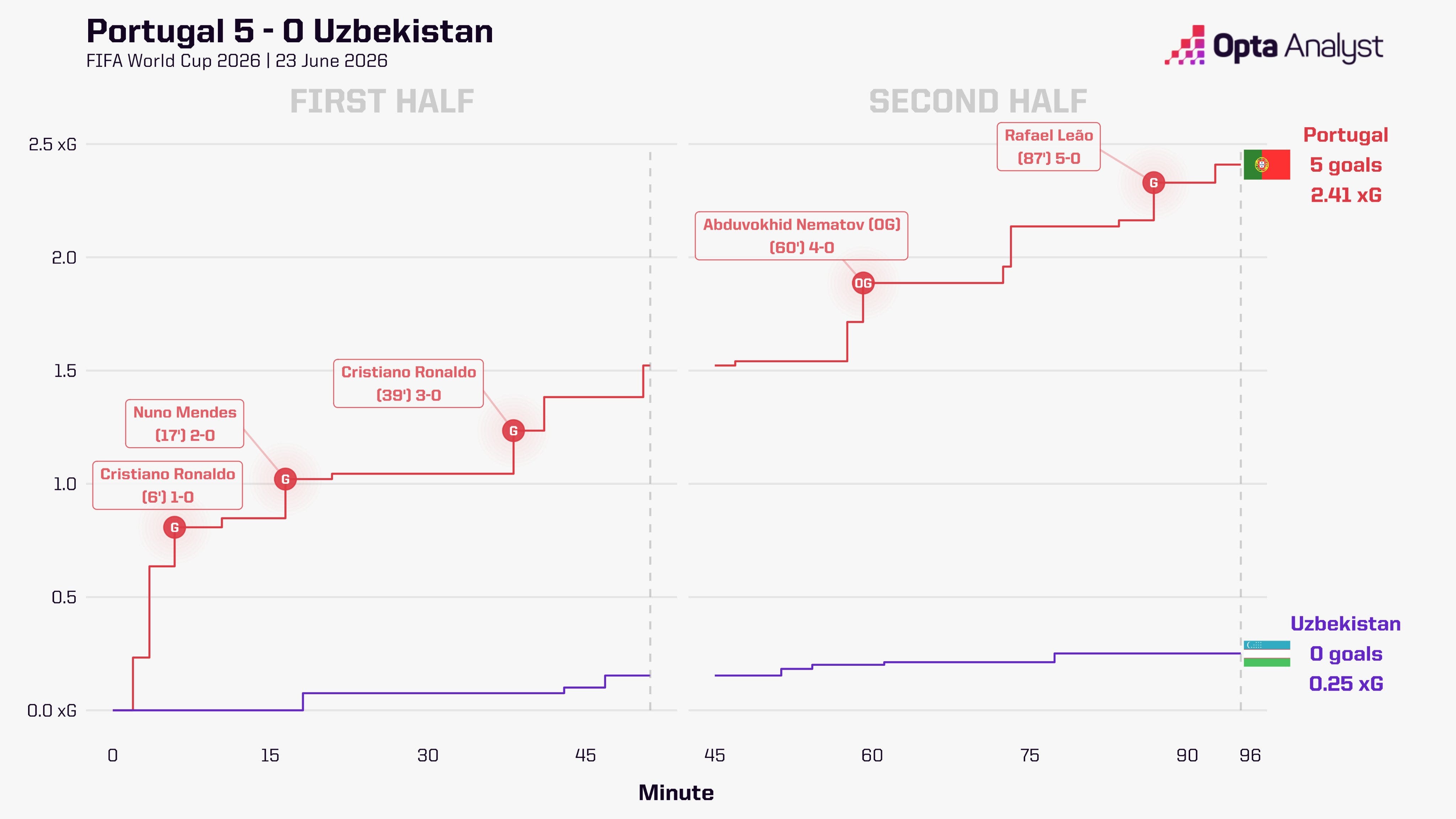
Things felt much better from the off this time for Portugal. Part of that was that Uzbekistan looked really poorly organised defensively (Fabio Cannavaro might not be it). They were not able to set up a low block. That helped Cristiano Ronaldo make better movements off the ball. We can see for his first goal that he’s drifting away from unaware defenders and getting into space really smartly. Even if he’s physically declined, this is the kind of situation where he has an advantage by thinking faster than everyone else.
The second goal really smartly took advantage of the fact that no one believed Ronaldo wouldn’t be too selfish to let someone else take a free kick. The game was already pretty open, but it really opened up for Portugal from there. Ronaldo’s next goal was a pure counter-attack. He was once the best transition attacker in the history of football, but now he’s merely useful in these situations. He’s still able to move surprisingly quickly in those moments, but he has fewer moments like that.
Portugal have so much talent on the pitch outside of Ronaldo. They’re very well suited to feeding killer passes into space on the break. This kind of game suits Portugal really well. The draw against DR Congo, meanwhile, showed that they can struggle against a more set defence. This might be a pattern in the tournament. Perhaps there’s another team that have some issues against low blocks we need to talk about.
England 0-0 Ghana
Carlos Queiroz is no stranger to taking on England in the World Cup group stages.
His Iran side did it last time in Qatar. England’s coaching staff were reportedly expecting “a dog of a game”. As it was, things went very smoothly and the Three Lions won 6-2.
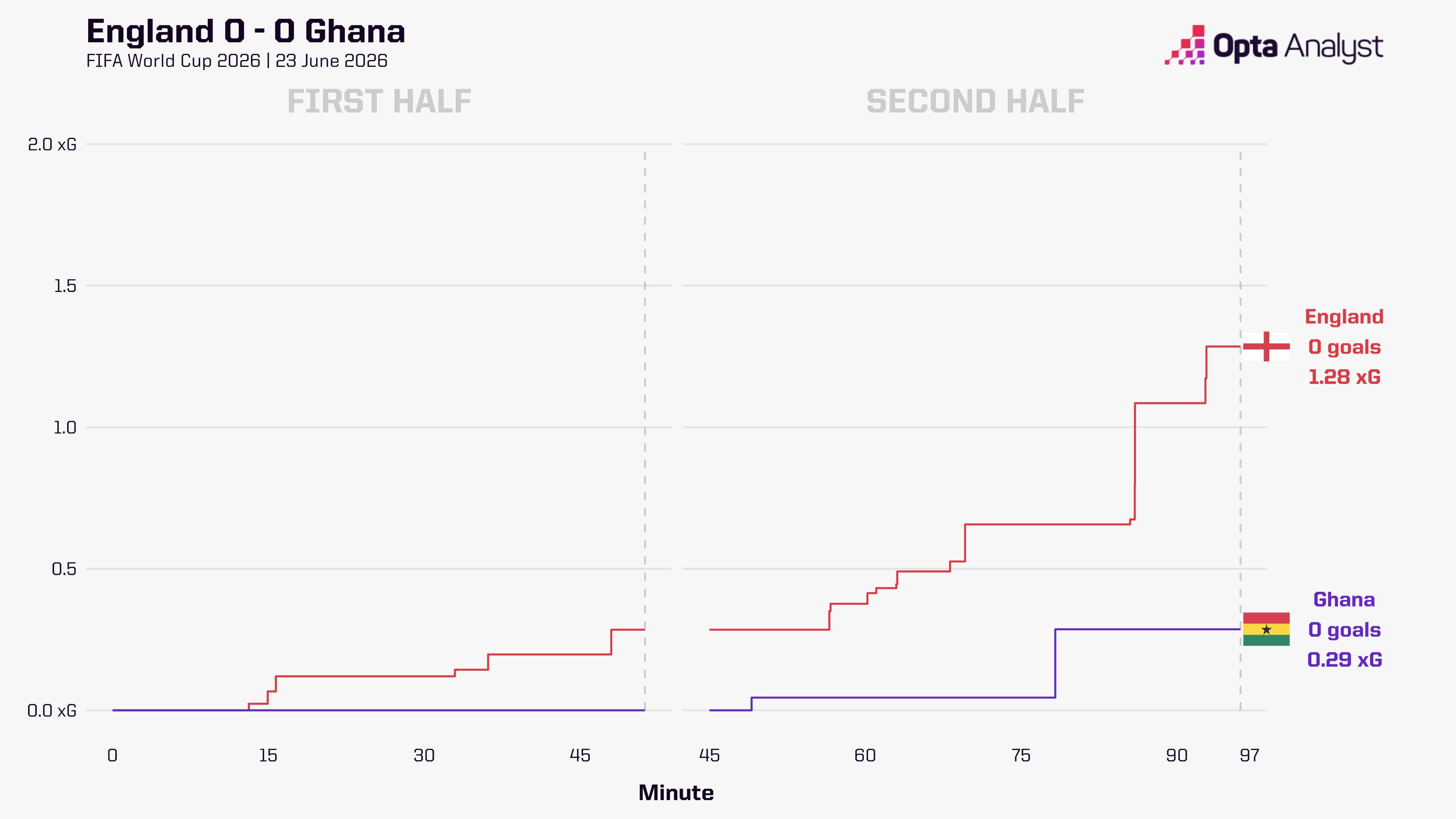
Well, four years and a manager change later, England got their dog of a game.