
World Cup: Day Five (APOLOGIES FOR LATENESS)

Hi, sorry everyone. A technical publishing error meant this didn’t come out when it was supposed to earlier today. Well, it’s here now, anyway.
Spain 0-0 Cabo Verde
Let’s talk about expected goals. Opta Analyst didn’t post the race chart this time, so here’s the one produced by Markstats.
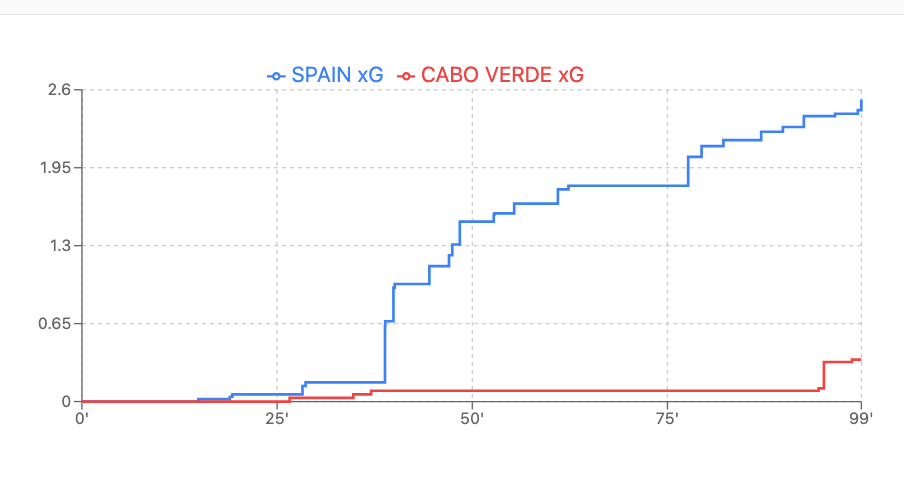
Spain had a lot of xG in this game. The easy read would be to say that they played well, having everything except composure in front of goal. It is true that if you run a thousand simulations of the shot data, Spain win this match most of the time. But I don’t think that’s the correct lens through which to look at this game.
Goals change games in large part because they change how both sides approach the match. If you’re ahead, you probably take the pressure off and protect your lead. If you need a goal, you’ll work harder to get one and accept the associated risks. Spain needed a goal for the entirety of this match, so they kept pushing to create chances. Had it been 2-0, they might’ve eased off in the second half and recorded a lower xG figure. Cabo Verde, meanwhile, were clearly very happy with a point and showed absolutely no attacking ambition. So while, yes, one of Spain’s chances usually goes in, the xG figure doesn’t mean Spain were, in my opinion, playing brilliant football here.
The question put before Spain, that’s going to run through a lot of this newsletter, is:
How do you stretch teams?
Spain had 74% possession today. Rodri, Aymeric Laporte and Pau Cubarsí all completed over 100 passes. They were constantly moving the ball around, passing it from one side to the other. All of that passing had exactly one aim in mind: get the ball in the back of the net. But unless people are making the right runs to stretch the play, the only place where that passing can go is sideways.
This has been a long problem for Spain, except when it isn’t. They produce such an abundance of central midfielders that they have a tendency to try and fit in an extra one out wide. This almost always leads to a lot of flat and stale possession as no one is stretching the play by staying wide and running in behind. At Euro 2024 they had Lamine Yamal and Nico Williams as genuine wingers, which magically fixed that issue. The striker was Álvaro Morata, who might not be the most complete striker in the world but did offer a lot in terms of presence and running in behind. Luis de la Fuente is certainly not a better manager than Luis Enrique, but he had the right players to implement the plan.
Two years later, both Yamal and Williams are in the squad, though both are recovering from injuries that put them on the bench against Cabo Verde. Morata had a poor season at Como and got left at home. So Spain started with Ferran Torres on the right, Gavi on the left, and Mikel Oyarzabal upfront. This is a very different front three to Yamal, Williams and Morata. Pedri is yet another midfielder Spain decided to play out wide. Oyarzabal has become a very useful striker, but he’s someone more likely to come short to receive the ball than Morata. Torres definitely likes to run in behind, but his starting position tends to be more narrow. He wants to come inside and shoot much more than he wants to beat his man and get chalk on his boots. They didn’t have a way of stretching the play.
Had Yamal and Williams both started, I’m confident they would’ve offered that directness in wide areas. What’s more, Cabo Verde would’ve had to get tighter to these players, and in the process opened up space in the middle. I would not enter crisis mode yet were I Spanish. But this team needs to get its star wingers fit if it wants to win the World Cup.
Belgium 1-1 Egypt
Next up in “how do you stretch teams?”
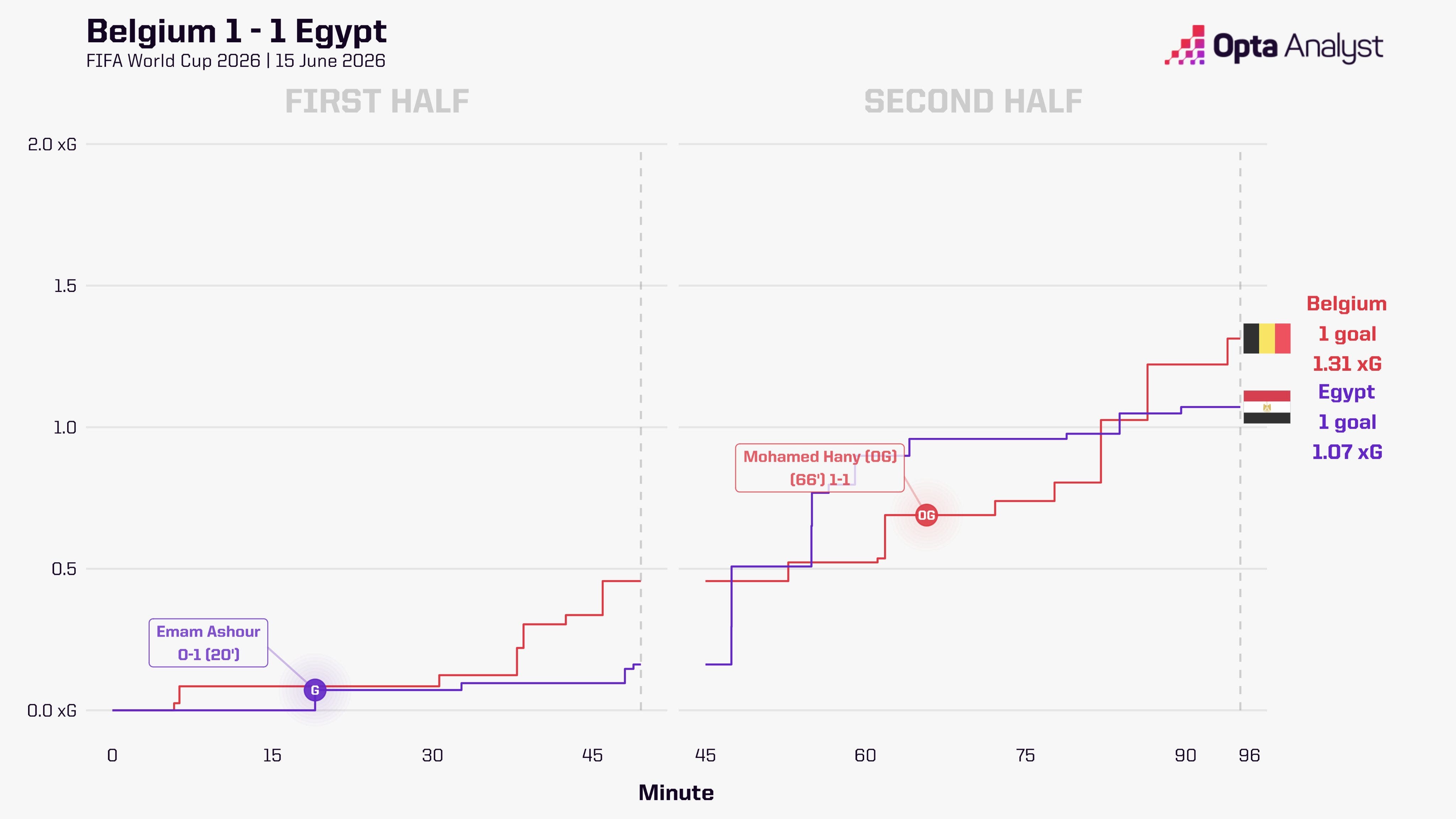
Belgium started with an attacking band of Leandro Trossard, Kevin De Bruyne and Jérémy Doku behind Charles De Ketelaere as the striker. De Ketelaere is not a number nine despite being massive, and while Belgium were making some decent combinations at times, it wasn’t really direct enough to cause problems. It was asking players to be interchanging and fluid with teammates they don’t spend all season training alongside. Trossard, say, does not instinctively understand De Bruyne’s movements the way he might for Martin Ødegaard. International football is a dumber version of the sport than club level because you don’t have time for intricate coaching.
Anyway, Belgium took off De Ketelaere for Romelu Lukaku after 66 minutes and they get the equaliser 22 seconds later. Right back Thomas Meunier runs down the flank and puts in a cross at the byline, but this time there’s someone making exactly the right run into the six yard box. Yes, it’s an own goal. But just having a striker make that run causes havoc in the Iran defence enough for it to end up in their own net. I’m sick of pretending you don’t need a proper centre forward at international level. False nines and interchanging rely on complex movements and teams defending higher up the pitch, which isn’t the case here. You need a presence. You need a killer.
International football doesn’t need multifunctional players who can fit fluid roles. I think Belgium would improve by simplifying the instructions here. “Kevin, pass. Jérémy, dribble. Romelu, get in the box.”
I don’t think either of these sides were particularly great. Perhaps Belgium improve if Lukaku can get fit enough to start. I guess we’ll see.
Saudi Arabia 1-1 Uruguay
Oh, Marcelo Bielsa, what’s happened to you?