
World Cup: Spain 1-0 Argentina
The final. The big one.

Everyone watching Spain at the World Cup could see something very obvious: they’re playing “Spanish” football.
It’s all short passing, calm possession, finding the right movement through patience and rhythm. It’s juego de posición. It’s exactly what we expect. It’s Spain. It’s the country’s footballing identity stretching back many generations. It’s who they are. It’s what they’ve always done.
Except that’s a complete lie. It’s Dutch total football filtered through a Catalan perspective with some Argentine ideas mixed in. Spain didn’t invent it at all, but they institutionalised it. That’s something they do better than anyone else.
Every empire needs a moral justification. It’s a lot harder to sleep at night if you admit you just invaded that place and oppressed those people for wealth and power. The British Empire told itself it was simply doing its duty to maintain order. “Of course it would be great for India to belong to the Indians, but they just aren’t yet civilised enough for it, so sadly it is our burden to rule over them and steal all their best stuff”. You have to tell yourself you’re getting into heaven somehow.
The Spanish did it slightly differently. The moral justification was about bringing people into the Catholic Church. They sometimes called it “La Monarquía Católica”, the Catholic Monarchy. That underpinned their whole propaganda: they were building civilisations in their image. New cities would be built. Spanish-speaking cultures would be established. Souls would apparently be saved.
After successfully conquering much of modern-day Mexico and Central America, and then what we now call Peru, the Spanish set their sights further down. There was, they believed, a mythical “Mountain of Silver” south of the already colonised Americas. This could offer vast riches, and yeah, of course, they could tell a bunch of natives that Jesus died for their sins, that’s definitely the important bit. The region would be known as the “Río de la Plata”, roughly meaning “river of silver”. The reality of all that silver didn’t quite live up to the hype, but the name stuck.
The area was initially part of the Viceroyalty of Peru (an absolutely huge area at one point covering most of South America), before eventually getting reorganised into its own Viceroyalty of the Río de la Plata. As Spain saw it, this was not an “empire” but a “monarchy”. Officially speaking, all of these viceroyalties separately belonged to one monarch, rather than being ruled by a “Spanish government” as such. Though in practical terms, major decisions were made by the Crown through institutions centred in Madrid, with the viceroys appointed to rule these places overwhelmingly coming from Europe, wealth flowing towards Spain, and indigenous people suffering in all the ways that colonised people tend to suffer.
Buenos Aires became the capital of the Viceroyalty of the Río de la Plata, a large region with parts covering modern Bolivia, Paraguay and Uruguay. When Napoleon invaded Spain and the ruling monarchy was in crisis, Buenos Aires elites moved to get rid of the viceroy and govern themselves. Some civil war stuff happens, you know the sort, blah blah blah, then some of the provinces formerly part of the Río de la Plata declare independence and become the country that would go on to be called Argentina.
The Spanish crown might have lost land to this new country called Argentina, and they certainly weren’t happy about it. But from a certain point of view, the important bit had been done. The state had been created in their image. The people there spoke Spanish, adopted many of Spain’s values and, crucially, followed the Catholic faith. “Hispanidad”, the later-applied term for a shared Spanish language, culture and values, had been successfully institutionalised.
Jump forward about 200 years, and the same thing happened again, but at the same time sort of in the reverse direction. Pep Guardiola’s Barcelona were playing the undisputed best football in Europe. With one very notable exception we’ll talk about soon, this was built with a core of Spain-eligible players: Carles Puyol, Gerard Piqué, Sergio Busquets, Xavi Hernández, Andrés Iniesta and Pedro. Spain’s new manager, Vicente del Bosque, was nothing like Guardiola. His previous teams were not easy on the eye. But he’d be a fool not to adopt the same style with these players.
Guardiola’s most famous influence was obviously Johan Cruyff. He spent the majority of his playing career at Barcelona under Dutch managers Cruyff and Louis van Gaal, with the club absolutely steeped in Ajax ideas about how to play football. But Guardiola’s Barcelona didn’t play a simple copy of totaalvoetbal. It became its own thing. For one, it had plenty of Argentine influence, with La Liga having long borrowed that country’s best players and thus ideas.
This was already part of Spain’s football identity before Guardiola, and arguably owes more to Real Madrid. Alfredo Di Stéfano changed the game when he arrived in the Spanish capital in 1953. While Spanish football had been more stiff and rigid up to this point, Di Stéfano could transcend position. He’d appear as a striker at one point, then drop deep to create at another. In doing so, he helped change the way Spain thought about the sport. Argentina almost became the ideas engine of Spanish football. Barcelona added that to the Dutch methods, showcasing a distinctly Catalan identity, and then Spain copied the whole thing.
Del Bosque wasn’t about to excite us all. He was always a cautious coach who believed in squad harmony over tactical philosophies. That meant putting Xabi Alonso next to Busquets in midfield and having the team play a much more patient passing game. His Spain were often pretty dull to watch. But the players were of such high quality, and the tactical understanding between them so instinctive in this style of play, that it worked incredibly well. As soon as they won that World Cup, everyone knew “Spanish football” had been reborn.
It was more conservative than Barcelona, more possession-based, and more tiki-taka. It had less room for explosively talented individuals. This has kind of become the Spanish philosophy, with so much priority placed on the collective passing game over players doing their own thing. Maybe that’s hitting something genuine in Spain’s cultural identity. Or maybe it’s just because they were trying to copy Barcelona without having Lionel Messi.
Argentina’s football has never shied away from brilliant individuals. They highly value the enganche, the classic number ten, as the figure who ties the whole team together. It became a core part of Argentine football throughout the 1960s and ‘70s, then transcended the sport itself when Diego Maradona played the role. Argentina’s manager at the 1986 World Cup, Carlos Bilardo, was not a footballing romantic. While his predecessor (also a World Cup winner) César Luis Menotti wanted to play brilliantly entertaining football, Bilardo was all about structure and discipline. Except for the number ten. Everyone stayed solid, then Maradona did his thing to win the game.
This tension between the Menotti and Bilardo visions has shaped Argentine football. But everyone can unite behind a brilliant enganche. Had he stayed in Argentina, Messi would’ve almost certainly developed in exactly this mould. He has all the skills of an enganche that he clearly learned as a kid in Rosario before moving to Barcelona and being shaped by the Dutch-influenced structure around him.
Messi understood the structural requirements of Guardiola’s team perfectly, but he was allowed to be the exception. Spanish doesn’t really embrace the same concept of an enganche, but it certainly understood a brilliant Argentine attacker who could interchange positions and do everything. Those dribbling skills, that change of pace, were very distinctly Argentine qualities that Spain loved, but couldn’t produce themselves in quite the same way. So the national team became more systematised, more coordinated, more passing and less dribbling. It was shaped by the absence of Messi.
Argentina, meanwhile, were trying to figure out how on earth they were supposed to use this guy who was very obviously their best talent since Maradona. Part of what makes Messi so great is that he combines the post-Cruyffian Barça ideas with the classic Argentine style. Various Argentina managers tried to figure out how to make that work outside of Barcelona. Do they go more European? Do they play him in “his Barcelona position”?
The answer, basically, was to treat him like the classic enganche he always would’ve been. He knows how to play the role better than anyone. Despite all those years abroad, he is still Argentine. As this tournament has gone on, we’ve seen Argentina recreate the classic Bilardo formula: everyone stays solid and makes the game absolutely dogshit, while the iconic number ten has the freedom to provide the quality. Which is, despite all the historical connections, the exact opposite of what Spain did here.
Ok, let’s talk about the actual football match. But I’ll be honest with you: there’s a reason I spent so long going on about history rather than the state of what we saw on the pitch here.
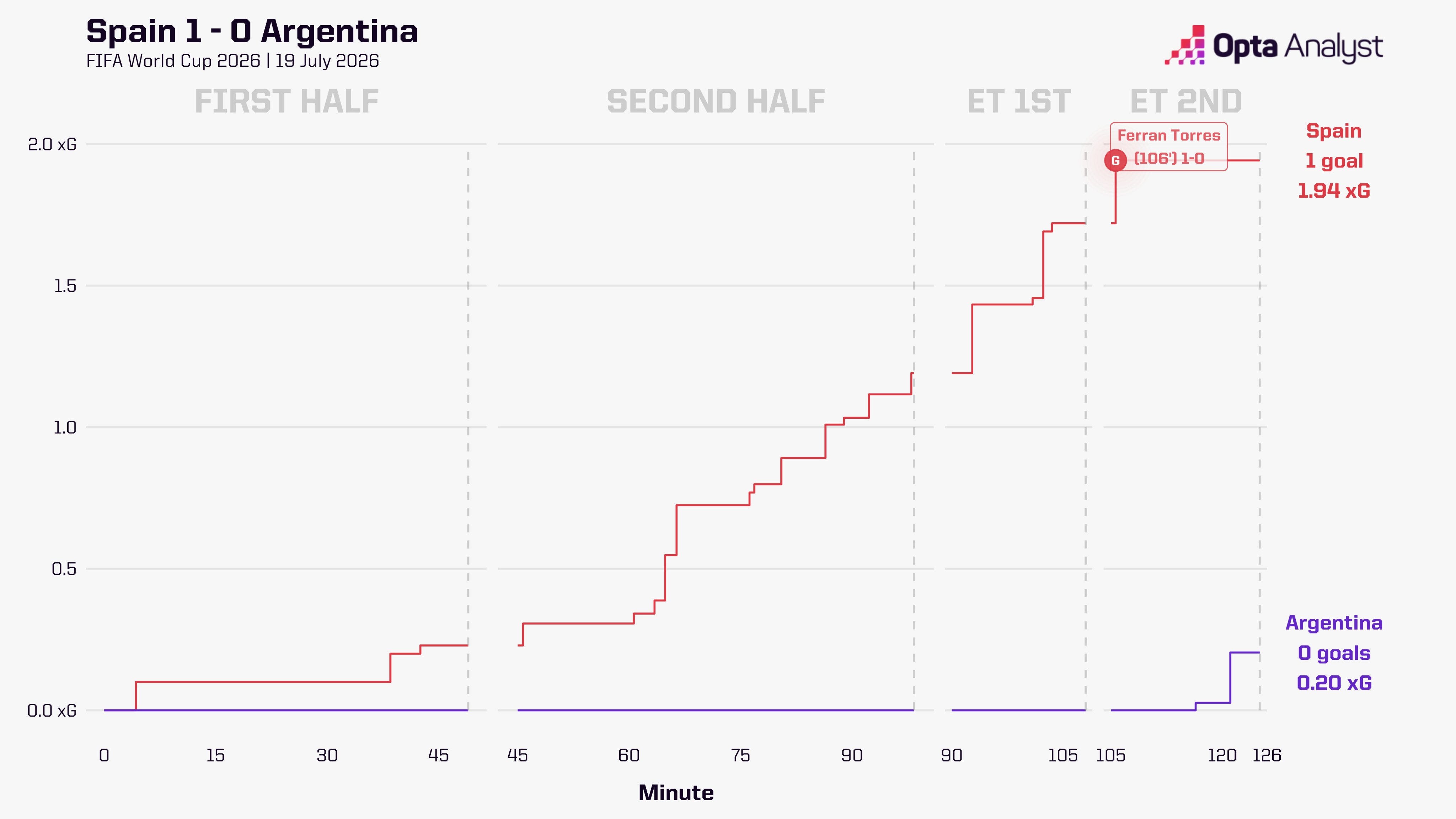
Look at that Argentina line on the xG race chart. They did not take a single shot until the 117th minute. Jorge Valdano, the brilliant former Argentine player who crossed the Atlantic and became one of Spanish football’s favourite tactical thinkers, once called José Mourinho and Rafa Benítez’ battles in the 2000s “shit on a stick”. Lord knows what he’d say about this first half, which truly felt soul-destroying. Spain had all of the ball in Argentina’s half, but Argentina were compact enough that the Spanish couldn’t do anything with it. It was the worst possible version of this match-up: Spain can’t always stretch a low block, and Argentina have no interest in anything other than making it unwatchable. Of the 22 players who started this game, only one (Julián Alvarez) had fewer first-half touches than Messi. If that isn’t a lack of ambition, I don’t know what is.
Options did start opening up as Argentina started to tire and leave some gaps. Luis de la Fuente’s subs were really good here. Pedri brought more imagination and spark, while Ferran Torres is the kind of striker who can stretch the play by running in behind, offering those good passers a through-ball option. Nico Williams, as I’ve said before, offers so much variety as a direct dribbling winger, and it’s a shame he hasn’t been fit enough to start games. Mikel Merino, meanwhile, let’s them chuck it in the box. The subs really had a quality of “yes, we have our one true way of playing, but here are some other toys”.
Argentina were really defending in their own box in the second half. They had mostly nullified the threat in the first half, but as the game went on, it really became a matter of everyone putting their bodies on the line. Spain were doing to them what they did to England. Then Enzo Fernández decided to get a stupid second yellow at the end of normal time. Great job, there. You know how it goes. You know your country suddenly comes to life in crucial moments. So you decide to make it basically impossible for Argentina to dominate the game in extra time.
It takes 105 minutes for the breakthrough. Pedro Porro overhits a cross that ends up all the way at the back post, which Williams does well to keep in play, only to pick out Torres making a driving run into the box to smash it in the back of the net. Everyone in the world knew that Spain deserved it on the day.
Torres was ten years old when Spain last won the World Cup. Williams was eight. Porro was ten. This is the generation who grew up watching that great team. This is the first generation to grow up in an era when Spain institutionalised tiki-taka. They’re the generation who make it look like it’s an ancient creed passed down for centuries. They’re the civilisation built in one image, all in service of that vision of how to play football. La Monarquía Tiki-Taka.
Argentina, as everyone could’ve predicted, suddenly started trying to play football once they conceded. Maybe do that at 0-0 when you have eleven players. Messi started having an impact, and Giuliano Simeone was a live wire even if he looks unnervingly like his dad. But it wasn’t enough. We all knew it wouldn’t be enough because Spain are a machine. They conceded one goal this entire tournament. One!
Argentina spent the last 20 years trying to make room for Messi as best they could. Spain tried to figure out a way of playing without Messi, and accidentally stumbled onto a footballing philosophy that became institutionalised as the Spanish way. That’s what Spain do. They take organise the whole culture around the ideas they like. Thankfully, this time it just leads to footballing success instead of brutal colonialism.
Argentina’s football culture is about submitting to the number ten figure. Spain’s culture is now about everyone submitting to the collective aims of the team. The side that lacked Messi beat the side that only had Messi.
Thank you to everyone who has read these newsletters during the World Cup. I’ve really enjoyed writing these, but I’m absolutely exhausted now, so I’m taking a long-scheduled week off. I’ll be back after that to talk about whatever footballing nonsense is on my mind. It’s somehow only a month until the Premier League starts again. I really need to sleep.
Thanks for your incredibly hard work Grace. It must have been gruelling to watch and write about so many games given the time zone difference.
I so love that you give us the history. Thx!