
World Cup: Day Two
USMNT sparkle, Canada grind


Another day, another two games I did enjoy for different reasons. At least when their own countries are playing, we saw that US and Canadian fans can absolutely deliver good atmospheres at the World Cup. I’ve zero complaints on that front today. Let’s get into it.
The first half of this newsletter will be free, and then the second half will be for paid subscribers only. These newsletters are going to run every single matchday. If you want to come along for the ride, I have a special offer running right now, giving you 20% off for a year. That’s £4.80/$6.40/€5.60 a month, or you can save in the long run by getting a whole year for £48/$64/€56.
Canada 1-1 Bosnia and Herzegovina
This game was played at a really high tempo, which made up for a lack of technical quality. If you can’t make it silky smooth, at least make it fast.
I have… complicated feelings about Canada head coach Jesse Marsch. I think he’s a really switched on coach who’s been pretty cutting edge about a lot of things, and he’s clearly a charismatic person capable of galvanising a squad. But I don’t like the model of play that he espouses. I think it has some pretty big issues he can’t solve without changing tack.
Brief history lesson: Marsch spent his playing career in the United States and Mexico, before becoming an assistant to Bob Bradley with the US side. Bradley’s USMNT were a pretty straightforward defensive side, working hard and sitting deep to make life difficult for more talented opponents. But Marsch’s bigger influence came from 2015 onwards, when he took over the New York Red Bulls and found himself inside the Red Bull organisation. He impressed enough to move to Red Bull Salzburg and then RB Leipzig, really getting exposed to the ideas of Ralf Rangnick. “That was like an explosion of ideas in my head”, Marsch said. “It really, I think, created a spark in me to be the trainer1 and the coach I am now”.
Rangnick’s Red Bull operation was built around a repeatable model of intense pressing, rapid transitions and fast vertical movement. It was all about forcing the opponents to make mistakes and pouncing, getting the ball into the half-spaces2 on the counter over and over again. It was genuinely revolutionary and clearly a set of ideas that shaped almost every top football side today. But I don’t think it’s an accident that no team playing this style of football has won a major European league title since Jürgen Klopp’s Borussia Dortmund in 2012 (his Liverpool side were different). It is far too easy to defend deep, sit in a low block, and just deny any transition opportunities. Rangnick and Marsch’s model of play can’t conceive of the most basic way to defend in football.
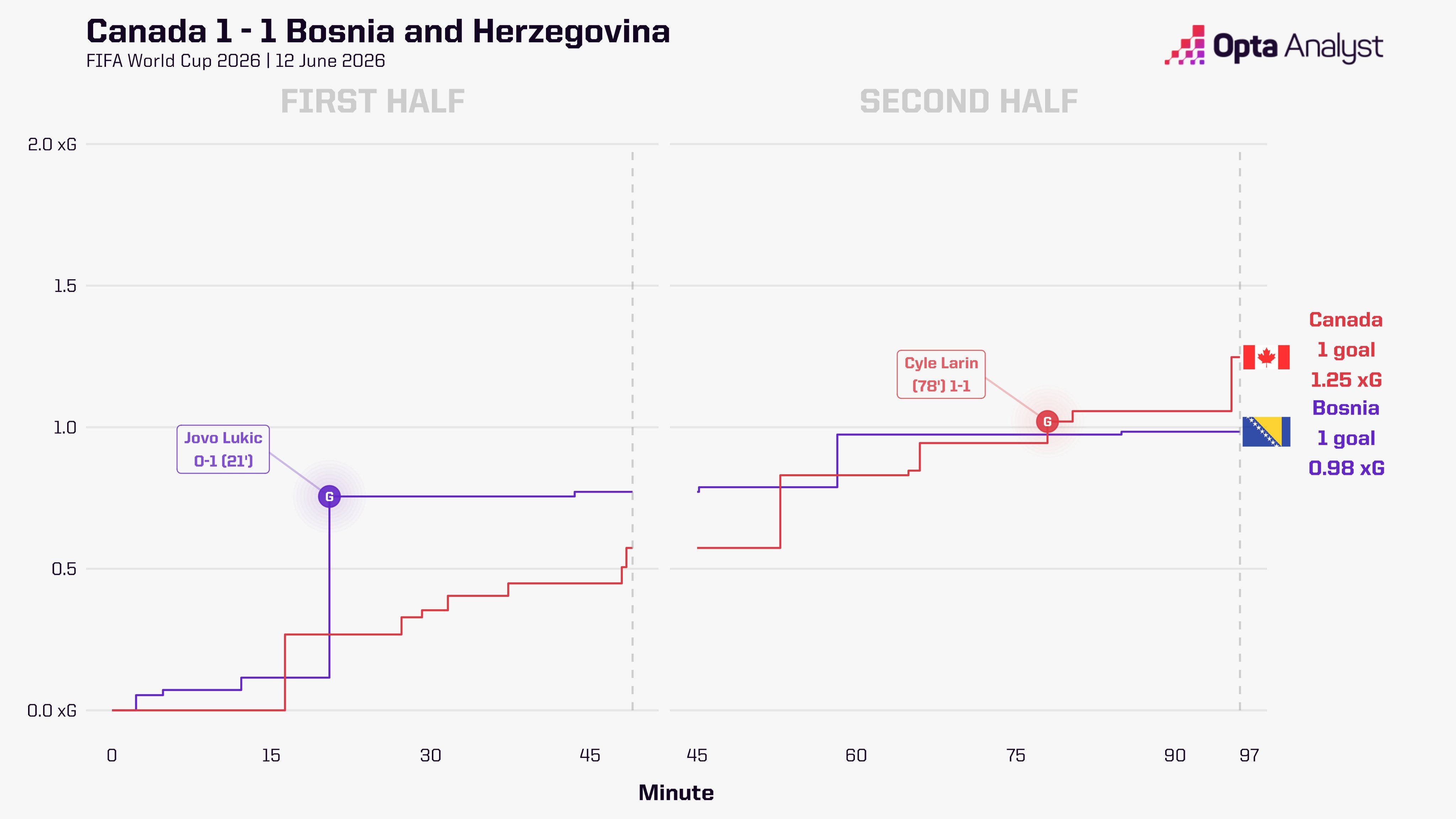
And so in this game, Bosnia and Herzegovina did sit fairly deep, inviting Canada to figure out answers here. This game was high tempo, and Canada were trying to force the issue without a great deal of smart football to create chances. It really felt like a set-piece match in the first half, with Bosnia getting ahead from a corner that I’m not sure could’ve easily been stopped. They meatwalled it. We’ve seen this all season in the Premier League. It was the only meaningful thing they did in that first half, but Canada didn’t produce much better.
Another Brick in the Meat Wall

Last summer, Brentford did something no other Premier League club has ever done or, likely, would ever have thought to do.
It wasn’t pretty, but Canada were getting better at brute forcing the issue in the second half. Cyle Larin got his goal by giving the team a focal point that they needed, receiving the ball with his back to goal and getting a really good shot away on the turn. To play this style of football, I think Canada are going to need a striker to do the job of holding the ball up more consistently. I know how crude it sounds, but it just makes it so much harder for teams to sit deep and creates a lot more options for Marsch’s transition game to work properly. Canada were the better side here, but not by enough that I think they deserved the three points. B-, good elements but room for improvement.
United States 4-1 Paraguay
Yep, that’s how you do it.