
World Cup: England 1-2 Argentina

Well that’s that, then.
Argentina advance to the final in the bid for a historic fourth star that would put them only one behind Brazil and cement Lionel Messi’s place as the undisputed greatest of all time. England, meanwhile, fail in the quest to win their first ever World Cup.
Ok, let me explain. It might take a while, though. Yes, this is a long one.
Yes, a country called England did win the World Cup in 1966. We have photo evidence from the tournament.
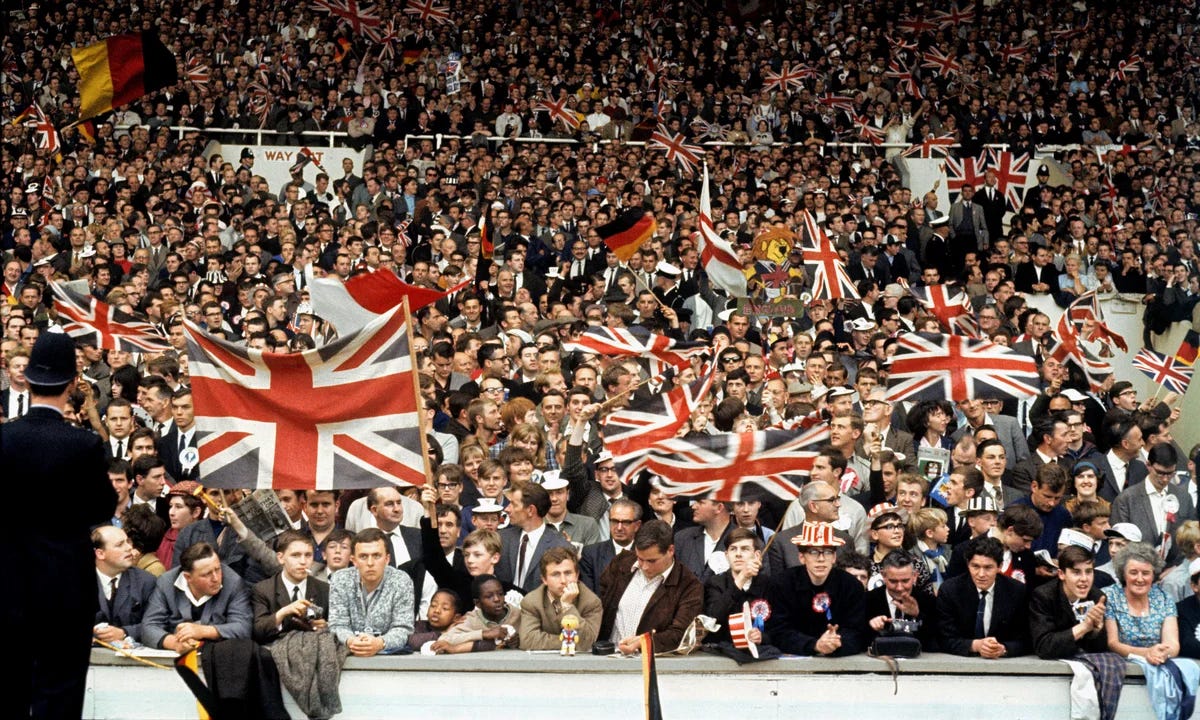
Wait, hold on a second. What’s that? That’s not the St. George’s Cross. That’s not the flag of England at all.
That’s the flag of the United Kingdom.
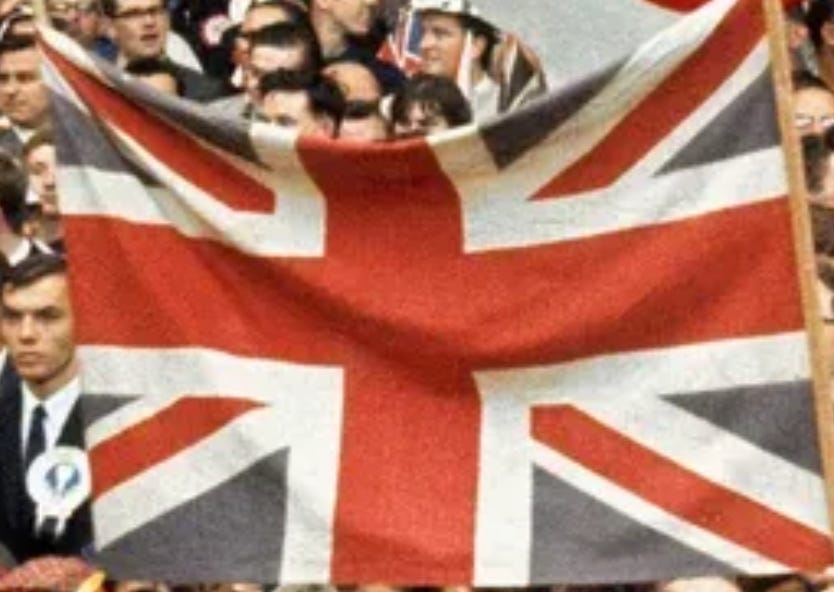
I wrote a whole thing previously about how “England” conceptually makes no sense, but until relatively recently, almost no one in the country itself seemed to notice. “England” did not need to have its own distinct identity because it was the centre of the most powerful empire on Earth. You didn’t have to think of Britain and England as separate concepts unless you lived somewhere that was part of the former but not the latter. For the English, the terms could be used interchangeably.
But nothing lasts forever. England Britain won the World Cup in 1966, but everyone understood it as a country in decline. The twentieth century was not the British century. The empire was shrinking day by day. The country told itself a great story of a small island standing strong in the Second World War, but this became a sort of projection to mask its shrinking influence. Geoff Hurst’s hat trick sort of came to sit alongside Winston Churchill’s speeches as a symbol of national victory when the real story was increasingly one of defeat.
By the 1970s and early 1980s, the empire’s continued decline sat alongside economic problems at home. Prime Minister Margaret Thatcher had won the general election specifically by exploiting these issues. “I do not intend to be the first woman Prime Minister of a mediocre and declining Britain”, she claimed. But it wasn’t going well in her first term. Then she got what must have felt like a gift from the heavens: Argentina’s military junta invaded the Falkland Islands.
Britain won the subsequent war pretty easily, and Thatcher wasn’t going to be shy about it a year before a general election. “We fought to show that aggression does not pay and that the robber cannot be allowed to get away with his swag”, she said. “There were those who would not admit it… people who would have strenuously denied the suggestion but—in their heart of hearts—they too had their secret fears that it was true: that Britain was no longer the nation that had built an Empire and ruled a quarter of the world.
“Well they were wrong. The lesson of the Falklands is that Britain has not changed and that this nation still has those sterling qualities which shine through our history.”
They weren’t wrong. It was obviously a country in decline in a lot of facets, including international football. After winning the 1966 World Cup on home soil, Britain England lost in the quarter finals in 1970, then failed to qualify for the ‘74 and ‘78 tournaments. They returned in 1982 and got knocked out in the second group stage without doing anything particularly embarrassing. But this was an astounding underperformance considering the talent available. English clubs won seven out of eight European Cup finals between 1977 and 1984.
That club dominance ended pretty dramatically after the Heysel stadium disaster in 1985. English clubs were banned from European competition for five years, with Liverpool getting an additional year. The “brand” of English football at the time was hooliganism, both domestically and abroad. The Sunday Times in 1985 called football “a slum sport played in slum stadiums and increasingly watched by slum people, who deter decent folk from turning up”. Football did not belong to the Britain that Thatcher wanted to reshape the nation into.
But nonetheless, England Britain playing Argentina at the 1986 World Cup had importance. Argentina had changed in the four years since the war. The military junta had given way to democratic rule. But this was still the country Britain had so effectively used as a punching bag four years earlier. This was the country that allowed Britain to very easily say “we’re still here, and we’re still serious players in the world”.
Not this time.
The defeat stung for three reasons. The first was that, well, the country had just prided itself on being vastly superior to Argentina as a nation. This was obviously not the case here. Diego Maradona was so far ahead of anything they could conceive of producing themselves. The second reason was, obviously, the manner of the first goal. Britain explicitly framed the Falklands war as Argentina “stealing” and “breaking the rules” of the natural order of things. Britain loves to pride itself on its “sense of fair play”. British moral logic looks at Maradona and thinks, “You’re good enough to beat us fairly, so why do you need to cheat?”
The implied Argentine response, at least from my (English, but sitting here in 2026) perspective, is: “these are your rules. We don’t have to play by them”. People had been kicking a ball around for millennia, but Britain decided, “these are the official rules the world must adopt”. British objections to Argentina’s approach felt more like an insistence that everyone must follow their own “international rules-based order”.
The third and most important reason was that the rest of the world sided with Argentina this time. Everyone understood it as a struggling and beaten-down country striking a blow against its rich and powerful enemy. This feeling went way beyond the Falklands. Most people in Scotland supported the British position on the islands, with some Scots even serving in the military victory, but you can be certain that viewers north of the border found it absolutely hilarious watching England lose like that. The other “home nations” were not, as some liked to imagine them, England’s little brothers. They were their own countries with their own interests.
Britain won the military war, but Argentina won the culture war. No image from the conflict in the Falklands was remotely as resonant as the Hand of God or the Goal of the Century. The game offered the cleanest possible metaphor for Britain England’s new place in the world. It was over. The presumed reality of a British ruling class over the globe was shattered by Maradona’s fist. It couldn’t hold. That country was ending with the empire. Something new would have to be born.
A new cultural idea around the national team started to take hold four years later. England were not particularly good at the 1990 World Cup. They won the group with five points and two goals in three games. They beat Belgium 1-0 after extra time in the Round of 16, then incredible arrogance and hubris saw them expect to run rampant against Cameroon, only to scrape by with a 3-2 win. And yet the tournament took on a kind of national romance. England lost on penalties to a better Germany team, but the national tone was “didn’t they do well”. They held a parade for coming fourth. This country used to brag about ruling a quarter of the world. Fourth!
But the romantic heartbreak narrative stuck. Two years later, the Premier League would start a wave of modernisation in English football. The country as a whole was going through a cultural rebirth, feeling more relaxed with its post-imperial self if the world still listened to Oasis and the Spice Girls. The Handover of Hong Kong, marking the widely accepted end of the British Empire, was on its way. Importantly, Euro 96 was to be held in England. This was a big opportunity to show the rest of Europe that England had moved on from the era of hooliganism with a more positive fan atmosphere and modernised stadiums.
But there was an interesting wrinkle. England had been drawn to play Scotland in the opening game. This fixture had never happened at a major tournament. Scotland itself was on the verge of getting its own parliament and government, providing a small crumb of independence. An England that had pretended itself to be basically the same thing as Britain suddenly couldn’t do it anymore. The country had to find a way to say “this is England, specifically England, not Britain”. The only major institution England had to itself was a football team, so that was where it had to start.
I doubt anyone knew they were doing it, but a decade after Maradona shattered the last remnants of the imperial image, a new national mythology was conjured up within one verse of a song:
“Everyone seems to know the score, they’ve seen it all before
They just know, they’re so sure
That England’s gonna throw it away, gonna blow it away
But I know they can play, ‘cause I remember”
Yes, “England” was invented in 1996 by Frank Skinner and David Baddiel. No, I’m not particularly happy about this, either.
To put it another way: England didn’t invent football. Football invented England.
We suddenly had a completely new framework to understand this country south of Scotland and east of Wales. It’s something like: “this country used to be impressive, but none of us can really remember it at this point. We’re all miserable gits about it, but if we all just believe, maybe something good can happen here again”. That’s England’s national mythology.
Euro ‘96 gave England another romantic failure following almost exactly the script of 1990: struggles, hope, belief, then heartbreak. That’s the narrative England almost want to see repeated over and over because the nation has learned how to process it. We can tell ourselves comforting stories of how Our Boys fought hard and just got undone. Unless it doesn’t feel that way. Unless England lose “wrong”. Then the conversation changes. Then the firing squads come out.
Thomas Tuchel made three changes from the side that narrowly beat Norway. Full backs Ezri Konsa and Nico O’Reilly were swapped out for Reece James and Djed Spence, which didn’t shock because Tuchel never seemed totally happy with his options there. The mild surprise was Morgan Rogers playing on the right ahead of Noni Madueke. Bukayo Saka (like a few Arsenal regular starters) has at no point looked fit enough to play 90 minutes, but Madueke had a shocker in the first half against Norway, so Rogers came in as an out-of-position third option. Lionel Scaloni only made one change, but it was significant: Giuliano Simeone for Rodrigo De Paul. Simeone is a much more direct wide player than De Paul, which changes the structure of the team.
The first half was… ugly. England’s plan was around pressing Argentina in central areas without the ball, and launching it quickly into the channels when they had possession. Argentina’s tactical tweak didn’t really work. Messi was playing as a striker in a sort of 4-4-2, with Julián Alvarez doing the pressing work for him, but the centre of the pitch was so crowded. He could never find much space. Conversely, England were trying to get the ball quickly into the half-spaces, but it wasn’t easy to find much rhythm there. The game was exciting because everyone was really up for it, but as a footballing spectacle, it was pretty dreadful.
The game opened up pretty much straight away after half time. Both teams were committing more players forward, with Tuchel and Scaloni probably both separately saying some version of “take the game to them”. I’m not sure this was a tactical choice or just about the player looking for space, but Messi started drifting out to the right more often as soon as the second half began. He’d done this in previous games, so it couldn’t be considered a shock, but the plan in the first half seemed to be to have Simeone holding the wide position with Messi more central. It changed in the second half.
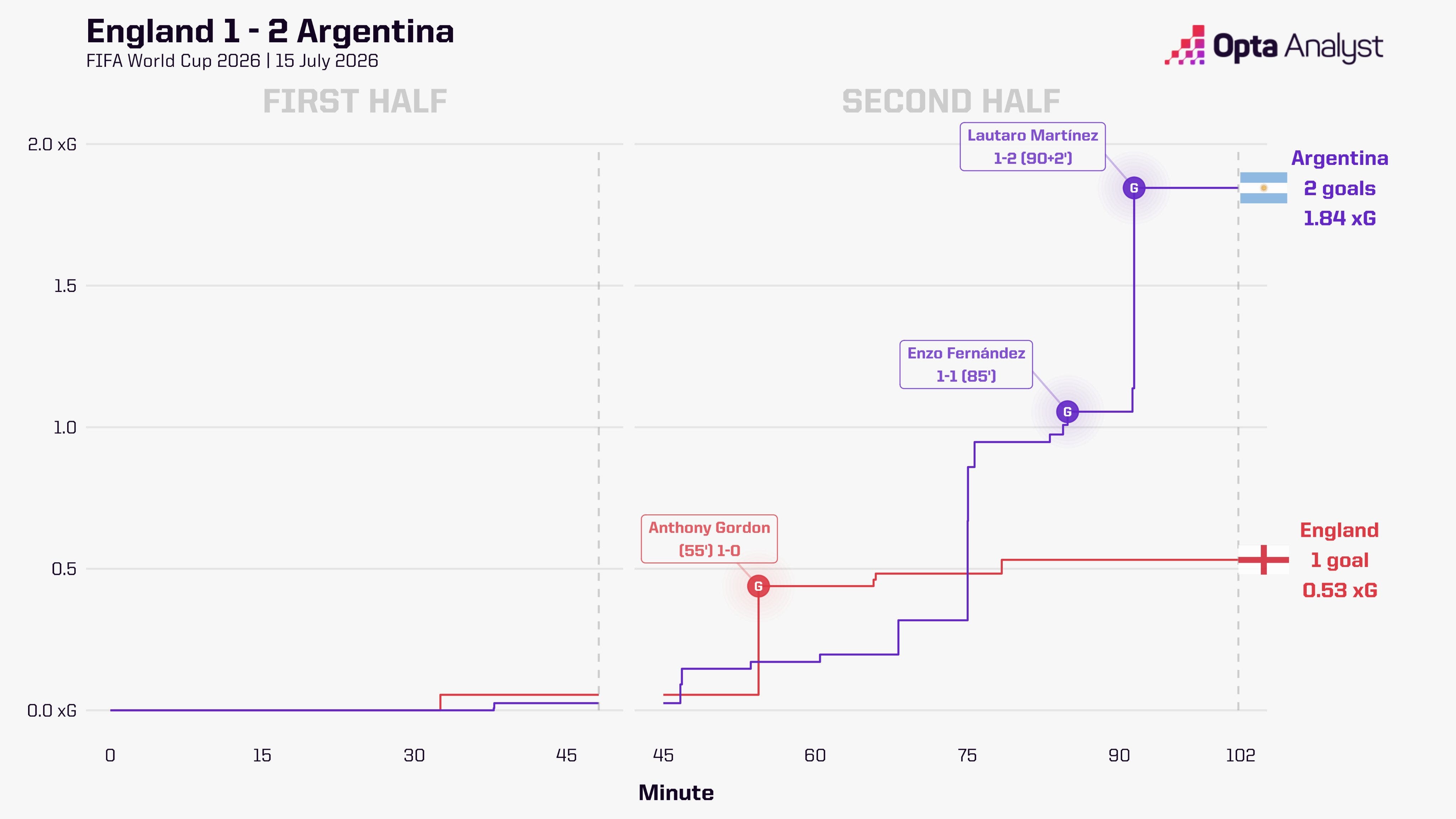
England worked the ball from back to front well for their goal. Harry Kane drops into a deeper midfield role and pings a ball over the top in that way he likes to do. Nicolás Tagliafico cuts the ball out, but England have started pressing, and he clumsily gives it straight to Declan Rice, who passes it sideways to Rogers. Then, Rogers puts in a decent cross in, with Anthony Gordon making a run at the far post so he can score the tap in. It’s a really good bit of football.
Hindsight is 20/20, and these are the kind of things you only analyse once you know what’s coming next. But everyone in the squad and the substitutes warming up all come together to celebrate the goal in a big huddle. That’s the way you celebrate when you make it 2-0 after 89 minutes and kill off any chances of the opponent equalising. It doesn’t feel like the celebration of “ok, nice one, now let’s get back to it”.
England initially respond by keeping the pressure on, trying to force Argentina in the first spell of possession after the game restarts. But then that high press leaves them a little exposed and Argentina get a chance through on goal, only for Spence to make a decent last-man challenge in the box. Argentina win a corner, which they take short. Then they have a throw-in which they take short, and use the opportunity of everyone back to pen England in their box a bit. You can feel the players’ mood shifting a bit here. They start to mentally retreat and feel like they shouldn’t push Argentina or really go for the second. Everyone starts thinking about defending their own box. Even Kane is right in there defending. When the Argentina players are knocking it around their halfway line, England players are getting back into shape more often than pressing to launch a transition here.
Tuchel hasn’t done or said anything yet. The players just sort of do it. This isn’t me trying to absolve Tuchel of all blame (we’ll get to his mistakes), but it’s a very predictable England pattern. It’s what they did in the semi against Croatia in 2018 (and, for that matter, the Round of 16 game against Colombia they won on penalties). It’s what they did in the Euro 2020 final against Italy. It’s just what England do when they go a goal ahead in a tough game. They retreat. They don’t instinctively think about defending in terms of proactive behaviour or keeping the ball.
Hear me out on this, but I found myself thinking of comments Gary Neville has made over the years about Pep Guardiola’s Manchester City team. “I always remember going back to [Guardiola’s] first season in England, and it wasn't a successful season if you remember”, Neville recalled, in the one searchable example of an anecdote he’s told a few times. “They didn't win the league in that first season and he said that the reason that they were conceding, he said it wasn't because they didn't have the physicality, it was because they didn't keep the ball well enough.”
The first time I heard Neville say this, he admitted to being surprised, because he felt they were losing games through conventionally British issues: defending the box, crosses, second balls, last-man challenges, etc. But when he saw Guardiola’s all-conquering City the next season, he got it. City were able to kill off games through control in keeping the ball.
The important thing is that this wasn’t an instinctive realisation for him, and I think it’s the same with most English players. They might intellectually understand that defensive possession is useful when you’re 1-0 up, but it’s not a tool they instinctively reach for. Crucially, it’s one that requires everyone’s buy-in. Whereas if a few players subconsciously start dropping deep, their teammates don’t really have a choice but to drop in and help the low block.
Every England player was sitting in their own third. They were giving Argentina time to work the ball from side to side, and giving a certain number ten room to work the passes he wanted. I’m not going to sit here and claim there’s some easy way to play against Messi. People have tried literally everything and none of it consistently works. But he wasn’t playing well in the first half. He started drifting wide because there was no room. Then England gave him all the time and space in the world, even as it was against a low block.
In the brief moments when England did win the ball back, it was all go. They were trying to pass it quickly up the pitch to get a second. English players don’t really think in terms of slowing it down. I’ve made this joke before, but we don’t even have a word for pausa. It’s all supposed to be now, now, now.
(I’ve realised I should write a whole newsletter about pausa, but for anyone who doesn’t know: it’s the Spanish and Latin American concept of a player pausing the game, taking a second to read the game with the ball at his feet, and waiting for the right option to present itself.)
Then the hydration break comes, and Tuchel makes the change. He takes off Gordon for another defender in Konsa. Tuchel’s argument after the game was that England were already dropping deep and had ceded control of the game to Argentina dominating possession, so if they were going to sit in a low block, he needed to do it properly by bringing on Konsa and switching to a deliberate back five. He made more defensive changes as things went, with Dan Burn and Nico O’Reilly coming on for Reece James and Declan Rice. Yes, O’Reilly was technically playing in midfield (which he can certainly do), but he was brought on for his defensive work.
Argentina start floating more and more brilliant balls into the box that are really hard to defend, even with five. That can happen when you’ve got Messi. For all that they were creating real chances, the equaliser they actually score is just a perfectly hit strike from range by Enzo Fernández. Jude Bellingham can’t quite close him down before he gets the shot away. There was only going to be one result after that. England couldn’t mentally shift into attack mode again after the way things had gone. So it was a question of whether Argentina’s winner would come before or during extra time. It was before. Messi gets to the byline and puts in a right-footed cross to Lautaro Martínez at the far post. Game over.
Tuchel’s argument about his substitutions was pretty much exactly what I’d expect him to say. Firstly, it’s a very pedantic position to take that lets him say he’s technically right while persuading almost no one. But it’s secretly about one of his long-term obsessions: how much information can you get across to players in the time available? In this moment, he decided he could not change the players’ entire mental framework of how to see out a game of football, so he made a rational but deeply unromantic choice of better managing the wrong decision they had already taken.
But the public had that tactical choice immediately framed by Wayne Rooney during BBC’s post-match coverage. I criticised BBC’s World Cup broadcast earlier in the tournament, but I think they got the tone exactly right here. Mark Chapman really brings the best out of Rooney, and that makes the whole panel work, but I’m getting distracted in an already way too long newsletter.
“When you make a decision, it’s a gamble, Rooney argued. “The gamble he made was to go with the five at the back, which allowed them to dictate the game. Then we couldn’t get out. They kept coming back, wave after wave after wave. Messi knew the space was on the right […] And all Argentina did was pick the second ball up, give it to Messi, let him go and do his thing. And we got punished.
“When Tuchel was making the changes, 100%, the players will have been stood on the pitch thinking “oh, no”. They would’ve known what was coming. They would’ve known it was coming at them. And they would’ve had to have a massive amount of luck to see the game out.”
Almost everyone in England has taken Rooney’s position on this. I think it’s worth giving Tuchel a little credit here. He did not sit there and think, “I want my team to defend in a low block once we go 1-0 up”. But he decided he couldn’t avoid it, and that gave the players an excuse to sink into their own box. The emotional message the players needed was to keep going, push higher up the pitch. Instead of Konsa for Gordon, the correct sub might’ve been something like Madueke for Rice. Then perhaps he could swap out Gordon and Kane for, say, Marcus Rashford and Ollie Watkins, giving England fresh legs ready to press hard. That would’ve given England more energy in the first line of the press while sending a clear message to those still on the pitch: do not sit on this.
But again, hindsight is 20/20. Perhaps Tuchel is right, and they would’ve done it anyway.
Then he said some things that really riled people up.
“I think ball possession plays a crucial role”, he argued. “It's maybe not in our DNA like it is in the Spanish DNA or Argentinian or Brazilian DNA to take the ball, control the game and the ball, which is also a big problem.”
On this one, I actually agree with him. “DNA” was probably not the best choice of words, as he’s obviously talking about “the way we instinctively play football” rather than going full eugenics on us (see: Gordon Strachan claiming he struggled managing Scotland because they were “genetically inferior”). But he’s describing a fundamental problem in even the most technically skilled English players. “He didn't bring Kobbie Mainoo on, who could handle the ball better than most”, Gary Neville said (shockingly starting with a Man Utd player). He didn’t bring Bukayo Saka on, who could probably handle the ball better than most. But he also left Phil Foden, Cole Palmer, Adam Wharton, Morgan Gibbs-White and Trent Alexander-Arnold at home, technical players.”
Ok, yes, those players are technically gifted. But which of them control games? Which of them put their foot on the ball and dictate the tempo, slowing down the play to find the right pass? We’re not talking about Sergio Busquets here. These are direct players who use their skills to open up games and create chances. They’re not players with pausa. English players don’t think in terms of slowing things down. They’re programmed to think about the “speed of the ball”, not about taking the time to make sure it’s going to the right place. This isn’t a wrong mental model. Cultures that prioritise patient passing can lack in areas where England are strong. But this is a much bigger, much deeper problem than not having “technical” players. It’s about how we think about using the ball, not how many #skillz you can do with it at your feet.
But that doesn’t absolve Tuchel of the choices he made. He said pretty consistently that he wants England to play on the front foot, bringing Premier League intensity to the World Cup, then changed his tone midway through the tournament. “It’s almost like every attack plays out like a fast attack”, he said after the Round of 32 win over DR Congo. “We need to worship more the moments and understand that sometimes, the door is closed. It doesn’t help if you rush into it. Try the other door! Find another way! And worship the ball-possession. Also, to recharge. Otherwise, we just run our batteries down with a huge effort and not so much reward”.
This sounds incredibly counterintuitive, but I think Tuchel spent 18 months doing everything to try and avoid exactly what happened in the last 20 minutes against Argentina. He wanted players to stay front-foot and keep pushing. He wanted them to be better at keeping the ball. He worked on these things specifically. But then, in the big moment, he saw it happening and concluded he was powerless to change things.
It is, viewed through the lens of cultural stereotypes, intensely German. It’s less “never say die” than “can we squeeze out a few more years before we pop our clogs?” And that’s part of what rubs people the wrong way here. There’s been a very classically British lingering feeling of “we’re cheating a bit by hiring a foreigner just because our own managers are rubbish, aren’t we?” People feel like they violated some unknown sacred code of conduct by hiring someone who isn’t just a foreigner but every bit the stereotype the English have of Germany. And that’s where the vitriol comes in. “We sold our soul to win it, and we weren’t any better than when we had Gareth Southgate”.
Some of the knee-jerk responses are a bit ridiculous. People seem to think that because he didn’t fix every problem, he needs to be sacked. Let’s let calm heads prevail here. Tuchel made mistakes. He didn’t do enough to deal with long-term structural weaknesses. As far as I’m concerned, unless Pep Guardiola makes the daftest decision of his life, Tuchel is the best realistic option.
But I want to see some changes. We need to see a sense during the Nations League games later this year that he’s thought about these problems and how to address them. England are playing home and away against Spain, Czechia and Croatia. Those are real matches where he can demonstrate new ideas on how England can improve. This was not a bad World Cup. It’s better than most of England’s tournament performances. But we need more if we want to win Euro 2028.
Yeah, this is the biggest gut punch of the whole cycle.
Losing the semi-final against Croatia in 2018 was disappointing, obviously, but it felt like the beginning. It was the start of being able to compete again after a true banter era. This England team would be back. There was genuine talent on its way coming from the youth sides. No one felt like it was the summit.
Losing the Euro 2020 final to Italy on penalties felt brutal, but the whole day had become such an exercise in toxicity around the stadium. It was ugly. It felt ugly. Don’t get me wrong, I would’ve been celebrating like mad if England won, but the whole atmosphere felt poisoned.
The 2022 World Cup quarter-final exit was the best England have played in any of these games. It just came too soon, and they lost in the fine margins against a good side. Aurélien Tchouaméni scores a screamer from distance and Harry Kane misses a penalty because that’s football. It was a big blow because England looked good in that tournament and could’ve gone far, but a really tough matchup that didn’t quite go their way came a little too soon.
Euro 2024 was a poor showing from the start. England looked obviously wrong. They played awful stuff in almost every game. There was a brief moment after beating the Netherlands in the semi-final where something felt like it might happened, but come on, we all knew England would need to hang on and get lucky against Spain. This team just got lucky with a draw that saw them to the final.
But this time? This one stings.
Euro 2028 is being held in the UK and Ireland, with England likely to play all of their games on home soil. That’s a far more favourable environment than the heat, travel and altitude we’ve seen them deal with at the World Cup. Football is, in the way the song originally meant it, “coming home”. Kane will be 34 years old, though most of England’s other key players should be at a good age. Tuchel is, from everything we’ve read, extremely likely to stay. Lessons need to be learned, but the focus has to be on looking forward. I’m certain there will be a lot of moaning between now and then. Everyone seems to know the score. They’ve seen it all before.
I still want to hope.