
Brazil at the 2014 World Cup: What Went Wrong?
Yes, that one

Hi, everyone. Sorry that this took a while, been a whole lot of life stuff happening, but this is a bumper newsletter. It’s another one of these retrospectives, on teams that were widely expected to be serious contenders in previous tournaments but, for whatever reason, it just didn’t happen at all. What went wrong? What are the key takeaways? Can we learn important things about how sides should approach the World Cup? I think these failures should tell us just as much as the success stories. Check out the previous editions: 2002, 2006, 2010.
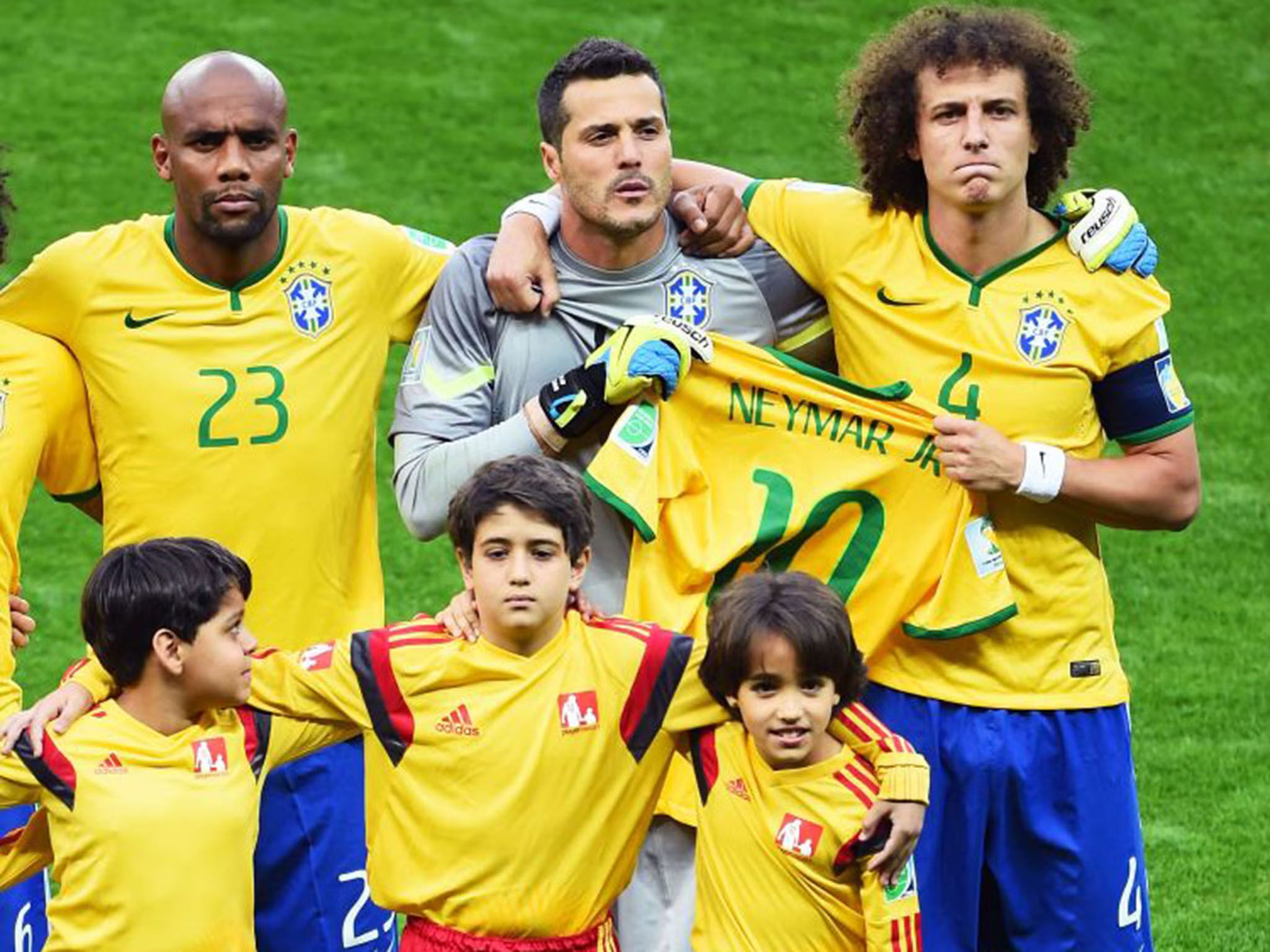
No side in my lifetime has been as heavily favoured to win a World Cup as Brazil in 2014.
Nate Silver, a man disliked by just about everyone now but widely praised in 2014 for his incredible ability to crunch the numbers and accurately predict major events, was all in on the Seleção. “This World Cup is being played in Brazil”, he wrote at the time. “No country has beaten Brazil on its home turf in almost 12 years. Brazil’s last loss at home came in a friendly on Aug. 21, 2002 [in a friendly where the side heavily rotated].
“To find a loss at home in a match that mattered to Brazil — in a World Cup qualifier, or as part of some other tournament — you have to go back to 1975, when Brazil lost the first leg of the Copa América semifinal to Peru. None of the players on Brazil’s current World Cup roster was alive at the time.”
Brazil, it seemed, tended to play very well on home soil. The domestic public were exceedingly confident. From the moment FIFA announced Brazil would host the tournament back in 2007, everyone expected this to be their moment. But it hadn’t been an easy ride to get there.
The bid was won a year after Brazil’s disappointing 2006 World Cup campaign, in which the side couldn’t make a group of superstars cohere into a team (I wrote about that here). The issue, in my opinion, was that Brazil were poorly structured in attack in 2006, not understanding how to manipulate space in order to get Ronaldinho, Kaká, Ronaldo and Adriano into positions where they could damage opponents, and having no ideas of how to break down low blocks. But that’s not really the conversation the Brazillian public were having. To them, this failure evoked a conversation dating back to the 1982 World Cup.
What Went Wrong? Brazil at the 2006 World Cup

Welcome to another one of these retrospectives, on teams that were widely expected to be serious contenders in previous tournaments but, for whatever reason, it just didn’t happen at all. What went wrong? What are the key takeaways? Can we learn important things about how sides should approach the World Cup? I think these failures should tell us just as much as the success stories.
Brazil played scintillating football in the summer of ‘82 in Spain. They earned plaudits around the globe for their style, even as they failed to make the semi-finals. But this was not acceptable in their native country, which prides itself on winning much more than the samba football stereotype suggests. “The 1982 side had demonstrably not won, and therefore they could only be classified as failures”, according to Tim Vickery, probably the foremost English-language expert on Brazilian football. “Dunga, 1994 World Cup-winning captain and coach of the 2010 side, once described the 1982 team as ‘specialists in losing’. The early elimination of 1982 hastened a rethinking of Brazilian football, a process which had already started when the 1974 side were outdone by the dynamism of the Dutch.
“The question remained the same – how to win. But the answer changed. Before it was based on possession, on passing, on finding a balance between attack and defence and then letting the talent free. Now there was an obsession with the physical development of the game. Two conclusions were drawn. One, that less space on the field meant more physical contact, so the central midfielders needed to be 6-footers to cope. Two, that there was no longer the room to play elaborate passing moves. The way forward was to counterattack, with quick thrusts down the flanks.”
This approach, I would personally argue, was part of the problem in 2006. They had no idea of how to score goals other than on the break. But domestically, it seemed that Brazil hadn’t committed enough to becoming a physical side. They needed to ditch the individualist superstar culture to win again. Dunga, the captain of the winning ‘94 side who had been so critical of the ‘82 generation, got the managerial job and played functional football. This team actually had some interesting ideas, but they were a tough watch, eliminated in the quarter-finals of the 2010 World Cup without many outside Brazil shedding a tear. But focus immediately shifted to the one they were destined to win, the one on home soil.
Mano Menezes took over the team. But after a poor Copa América in 2011 followed by losing the final of the 2012 Olympic tournament, Menezes was out. The view internally seemed to be that Brazil needed an experienced head, someone who knew what he was doing. So Brazil did what they so often do and hired someone who managed the side before. Luiz Felipe Scolari, popular for the 2002 World Cup win, returned to the job.
I really liked the 2002 Brazil team. Scolari played a 3-4-3 that perfectly suited his squad, using Cafu and Roberto Carlos to provide the width as wing-backs while creating space for the famous front three of Rivaldo, Ronaldinho and Ronaldo. The manager got it exactly right, even if he kind of stumbled into the system. After winning the World Cup, Scolari decided to try his luck in Europe, coaching the Portugal national side to some decent tournament runs without winning a trophy. This earned him arguably his most challenging job to date, as coach of Chelsea. His time at Stamford Bridge was a huge mess in which he didn’t last the season, seriously damaging his reputation and ending the notion that he could be called a “top” manager.
Scolari took a very high-paid job in the Uzbekistan Super League before heading back to his native country, briefly managing Palmeiras before losing the job. Then Brazil called and he was back as though the last decade never happened. In his second spell, Scolari prioritised dressing room cohesion above all else. He wanted this team to be a team, so he kept a close-knit squad that many talented players couldn’t break into. This was his group, and no one was changing his mind. The football itself was, well, it wasn’t great to watch, but Brazil had told themselves that this is how you win. Brazil were victorious at the Confederations Cup a year earlier, memorably beating Spain 3-0 in the final. That served as the template for Scolari, to the point where his starting eleven at the World Cup was the exact same team that played almost every match the previous summer. These were the players who had earned the manager’s trust, and no one else was going to change that.
Júlio César had been Brazil’s established number one goalkeeper since 2007 and that wasn’t going to change. He wasn’t exactly in the form of his life, though, and his club career had fallen from winning the treble with Inter Milan to getting loaned out to Toronto FC by Queens Park Rangers. But he was the big name who had to start, so that was that.
Dani Alves came off a bit of a disappointing season at Barcelona, but he was still widely considered one of the world’s best right backs, so he was an easy pick. Thiago Silva, along with being the captain and key dressing room figure, was arguably the world’s finest centre back at the time and rightly the side’s second most important player. He had a strong connection with David Luiz, justifying that player’s selection which many in England raised their eyebrows at. You know who David Luiz is. His ability on the ball far exceeds the vast majority of centre backs but he produces some infamous clangers that got Gary Neville to compare him to a “Playstation defender”. Things were generally better at Brazil because Thiago Silva was the organiser. We’ll see how that pans out. Left back was another pretty straightforward pick, with Marelo in his prime at Real Madrid.
Things get controversial in midfield. Luiz Gustavo of Wolfsburg was a useful midfield destroyer, and made a lot of sense even if he wasn’t the most exciting player in the world. Next to him was an absolute sure thing in Scolari’s head: Paulinho. At the Confederations Cup, Paulinho had been a key player, showing exactly the box-to-box energy that impressed Tottenham enough to sign him from Corinthians for £17 million. But the move had been a disaster, and Paulinho was clearly low on confidence. Even at his best, Paulinho was a limited passer, best at working hard and crashing late in the box. If this double pivot worked properly, it would be all about physicality and offer little in terms of technique and passing range. Brazil wouldn’t be able to build up by passing the ball calmly through midfield, and would have to rely more on the full backs to get it up the pitch.
The team’s superstar and most important player, obviously, was Neymar. He had already scored 31 goals in 48 matches at age 22. It’s hard to emphasise just how good Neymar was for the national team, dominating the side in a way no one else really had for decades. We’re used to Brazillian superstars but, in terms of Seleção importance, this was something beyond that of Kaká, Ronaldinho, Ronaldo, Rivaldo or Romário. This was Neymar’s team.
Neymar had generally played on the left, but often liked to move inside, and at this tournament played as a number ten. That meant his foil, Chelsea’s Oscar, playing out wide. Oscar was the perfect tactical counterpart to Neymar, all about making intelligent movements and working hard for the team. On the other flank was Hulk, who did not do those things. Hulk was another physical player whose game was mainly about running and shooting from range. He had scored goals in Portugal and Russia without getting tested in a top league. My hunch is he wouldn’t have made the grade against tougher opponents. But Scolari trusted him, and that was all that mattered.
Upfront, Brazil were in something of a crisis, lacking anything close to a top level centre forward. Ok, that’s not entirely true. Diego Costa had been one of the best strikers in Europe that season, and played for the Seleção as recently as March 2013. But, for whatever reason, he didn’t convince Scolari during that single international break, and was left out of the Confederatons Cup squad that summer. Costa then decided to make the switch to play for Spain. Scolari wasn’t to know that Costa was about to go supernova in the 2013-14 season but, at the same time, Costa knew that the Brazil squad was a closed shop he wasn’t getting into. I suspect Scolari would’ve left Costa out of the squad anyway.
That meant we had Fred upfront. He became a figure of ridicule, but Fred was a perfectly serviceable target man. His job in this team was to create space for Neymar much more than trying to score goals himself, which is fine. The whole side, really, is built around optimising for Neymar. It wasn’t ideal that Neymar himself had struggled a little in his first season at Barcelona, but the feeling was that this wouldn’t matter in a Brazil shirt. This was his time.